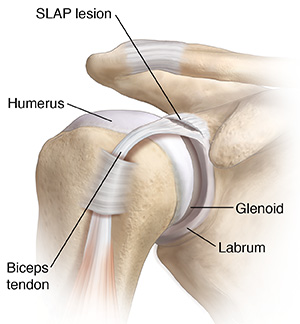
A SLAP lesion is a shoulder injury. It happens when there is a tear in the upper part of the labrum. This is the fibrous cartilage that helps hold the shoulder joint in place. Surgery can repair this injury. This surgery may be done through a few small cuts (incisions), called arthroscopic surgery. Or it may be done through 1 larger incision, called open surgery. You and your healthcare provider will discuss which method is right for you.
Preparing for surgery
Do's and don'ts:
-
Tell your healthcare provider what prescription and over-the-counter medicines you take. This includes vitamins, herbs and supplements, aspirin, and ibuprofen. Ask if you should stop taking any of these before surgery.
-
Follow all directions you are given for not eating or drinking before surgery.
-
Bring any X-rays, forms, or scans your provider needs with you to the hospital.
-
Arrange for an adult family member or friend to give you a ride home after the procedure.
During surgery
During surgery, your surgeon will closely examine your shoulder. One or more repairs may be done:
-
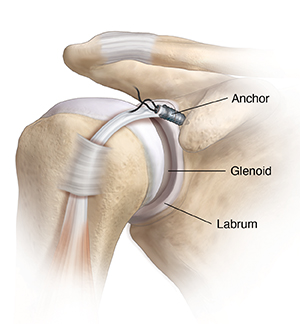
The labrum may be reattached to the glenoid using surgical anchors or stitches (sutures).
-
Other damage to the shoulder may be repaired. This includes tightening the capsule. This is the sheet of tough fibers around the glenoid and humerus.
Possible risks and complications of shoulder surgery
Here are some of the possible risks and complications:
-
Infection
-
Bleeding or blood clots
-
Damage to nerves or blood vessels
-
Stiffness or pain
-
Shoulder problem comes back
Featured in
Online Medical Reviewer: L Renee Watson MSN RN
Online Medical Reviewer: Raymond Turley Jr PA-C
Online Medical Reviewer: Thomas N Joseph MD
Date Last Reviewed: 04/01/2024
© 2000-2026 The StayWell Company, LLC. All rights reserved. This information is not intended as a substitute for professional medical care. Always follow your healthcare professional's instructions.
Need Help? We're Here for You
Our Member and Recipient Services Team is here to help you understand your benefits, find care, or resolve concerns.
800-510-9132
Call NC Quitline
Need support to quit smoking, vaping, or to quit other nicotine products? You can receive support including medicines free of charge:
800-784-8669
Schedule Transportation
Need transportation to a doctor's office, pharmacy, or other covered healthcare service? Contact us to arrange your ride.
800-510-9132
Provider Directory
Need to find a provider like a Primary Care Physician, Specialist, OB/GYN, or a Psychiatrist?
Provider DirectoryRelated Articles
Your Amputation Surgery
Amputation is surgery to remove a limb. Learn about the surgery and what to expect after.
Foot Surgery: Bunions
A bunion is a bony bump. When the distance between the first and second metatarsal bones of the foot is greater than normal, the big toe may turn toward the other toes. A mild bunion may then form causing foot pain and swelling. Bunions are most often found near the joint at the base of the big toe. Bunions tend to run in families. They may cause pain, swelling, and skin irritation.
Shoulder Joint Surgery: Bankart Repair
A Bankart lesion is a shoulder injury. It happens when there is a tear in the labrum. This is the fibrous cartilage that helps hold the shoulder joint in place. Surgery can repair this injury.
Upper Body Exercises Before Surgery or Procedure: Help with Walker or Crutch Use
Doing exercises before your knee replacement can help speed your recovery. These exercises build upper body strength. This can help you when you’re using a walker or crutches to get around after surgery. Your physical therapist or surgeon may advise you to use weights to make the exercises more effective. Follow your healthcare provider’s instructions.,