The cervical bones (vertebrae) are the top seven bones of your spine. They are located along your neck, just below the skull. Fusing vertebrae in the neck may help ease neck and arm pain. It may also help relieve progressive paralysis caused by compression of your nerve roots or spinal cord. Two or more vertebrae in your neck are fused. Fusion may be done through a cut in the front or the back of the neck. The surgery can take from 1 to 4 hours.
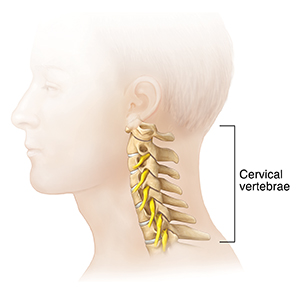
The fusion procedure
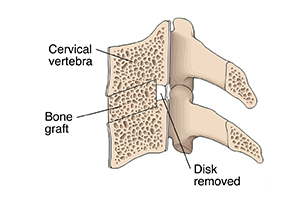
These steps apply to fusion from the front of the neck:
-
A head clamp or strap may be put on to align your neck.
-
The skin is cut and the muscles, blood vessels, trachea, and esophagus are pushed to one side to get to the vertebrae and disks.
-
An X-ray is done to check that the right spinal level is being operated on.
-
The disk is removed from between the vertebrae to be fused.
-
Bone spurs are removed.
-
A bone graft or intervertebral implant filled with bone is placed into the now-empty space between the vertebrae. Screws, plates, or a plate with screws are often placed in to ensure additional stability. In time, the graft and the bone around it will grow into a solid unit.
-
To help keep your spine steady and promote fusion, extra support with a cervical collar may be used.
-
A drain can be left in the wound for 1 or 2 days.
-
The incision is closed with stitches, glue, or staples.
-
A neck brace, rigid or soft, might be placed on your neck.
Online Medical Reviewer: Anne Fetterman RN BSN
Online Medical Reviewer: Luc Jasmin MD
Online Medical Reviewer: Raymond Kent Turley BSN MSN RN
Date Last Reviewed: 09/21/2013
© 2000-2026 The StayWell Company, LLC. All rights reserved. This information is not intended as a substitute for professional medical care. Always follow your healthcare professional's instructions.
Need Help? We're Here for You
Our Member and Recipient Services Team is here to help you understand your benefits, find care, or resolve concerns.
800-510-9132
Call NC Quitline
Need support to quit smoking, vaping, or to quit other nicotine products? You can receive support including medicines free of charge:
800-784-8669
Schedule Transportation
Need transportation to a doctor's office, pharmacy, or other covered healthcare service? Contact us to arrange your ride.
800-510-9132
Provider Directory
Need to find a provider like a Primary Care Physician, Specialist, OB/GYN, or a Psychiatrist?
Provider DirectoryRelated Articles
Foot Surgery: Bunions
A bunion is a bony bump. When the distance between the first and second metatarsal bones of the foot is greater than normal, the big toe may turn toward the other toes. A mild bunion may then form causing foot pain and swelling. Bunions are most often found near the joint at the base of the big toe. Bunions tend to run in families. They may cause pain, swelling, and skin irritation.
Your Amputation Surgery
Amputation is surgery to remove a limb. Learn about the surgery and what to expect after.
Knee Arthroscopy for a Ligament Tear
Knee arthroscopy is used to diagnose and treat a ligament tear using an arthroscope.
Achilles Tendon Repair Surgery
Achilles tendon repair surgery is a type of surgery to fix a damaged Achilles tendon. Learn more about the surgery, including why you might need it, what the risks are, how to get ready for it, and what happens during and after the surgery.