Treatment will depend on how bad your sprain is. For a severe sprain, healing may take
Right after your injury: Use R.I.C.E.
-
Rest: At first, keep weight off the ankle as much as you can. You may be given crutches to help you walk without putting weight on the ankle.
-
Ice: Put an ice pack on the ankle for up to
20 minutes at a time. Don't put ice directly on your skin. To protect your skin and prevent skin damage, wrap the bag in a clean, thin towel or cloth. Remove the pack and reapply every2 to 3 hours or as directed by your healthcare provider. Repeat for up to3 days. This helps reduce swelling. -
Compression: To reduce swelling and keep the joint stable, you may need to wrap the ankle with an elastic bandage. For more severe sprains, you may need an ankle brace, a boot, or a cast.
-
Elevation: To reduce swelling, keep your ankle raised above your heart when you sit or lie down.
Medicine
Your healthcare provider may suggest oral nonsteroidal anti-inflammatory drugs (NSAIDs), such as ibuprofen. This relieves the pain and helps reduce swelling. Be sure to take your medicine as directed.
Exercises
You may be given exercises to strengthen the ligaments and muscles in the ankle. Doing these exercises will help prevent another ankle sprain. Your healthcare provider may also refer you to a physical therapist. A physical therapist can help develop a rehabilitation program aimed at rebuilding strength and range of motion of your ankle and help treat pain. Ask your healthcare provider when it is safe to begin exercises.
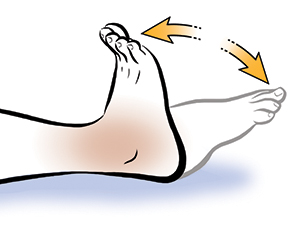
Range of motion exercise:
-
While sitting, use the big toe of the injured foot to trace the alphabet (upper- and lower-case). Do this for
2 to 3 minutes3 times per day.
Online Medical Reviewer: Rahul Banerjee MD
Online Medical Reviewer: Ronald Karlin MD
Online Medical Reviewer: Stacey Wojcik MBA BSN RN
Date Last Reviewed: 09/01/2025
© 2000-2026 The StayWell Company, LLC. All rights reserved. This information is not intended as a substitute for professional medical care. Always follow your healthcare professional's instructions.
Need Help? We're Here for You
Our Member and Recipient Services Team is here to help you understand your benefits, find care, or resolve concerns.
800-510-9132
Call NC Quitline
Need support to quit smoking, vaping, or to quit other nicotine products? You can receive support including medicines free of charge:
800-784-8669
Schedule Transportation
Need transportation to a doctor's office, pharmacy, or other covered healthcare service? Contact us to arrange your ride.
800-510-9132
Provider Directory
Need to find a provider like a Primary Care Physician, Specialist, OB/GYN, or a Psychiatrist?
Provider DirectoryRelated Articles
Foot Surgery: Plantar Fascia Problems
Your plantar fascia is the ligament that extends from the heel of your foot to the ball of your foot. If your foot flattens too much or too little as you move, you may strain your plantar fascia. While the vast majority of people with plantar fascia pain can be helped with nonsurgical treatments, surgery can be considered if these treatments fail.
Understanding Upper Arm Fracture Open Reduction and Internal Fixation (ORIF)
Open reduction and internal fixation (ORIF) is a type of treatment to fix a broken bone. It puts the pieces of a broken bone back together so they can heal.
Microdiskectomy
During a microdiscectomy, some disk is removed. In most cases, bone must first be removed to expose the damaged disk. The part of the disk outer wall and soft center that presses on the nerve can then be removed. There is usually enough disk remaining to cushion the vertebrae.
Knee Arthroscopy
Arthroscopy is used to diagnose and treat knee problems through several small incisions in the knee.