Having scoliosis means that your spine (backbone) curves and twists from side to side instead of growing straight. Your healthcare provider will suggest the best treatment for you based on your age, how much more you are likely to grow, and the size and type of your spinal curve.
How is scoliosis treated?
The three types of treatment for scoliosis are:
-
Observation. Watching a small curve to see if it gets better or worse as you grow.
-
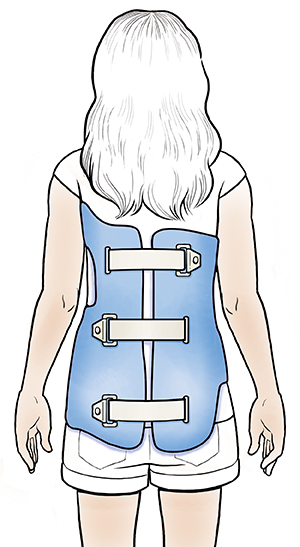
Bracing. Wearing a brace until your spine is fully grown to keep your curve from getting worse. For many teens with scoliosis, wearing a brace is the best treatment. It may also help keep you from needing surgery.
-
Surgery. Operating to correct a very serious curve.
How a brace works
-
A scoliosis brace is made out of plastic and is shaped to fit your body. The brace holds your spine in place to keep your curve from getting worse. To do this, you need to wear it almost all the time until you are fully grown.
-
There are several kinds of braces. Your healthcare provider will talk to you about the best one for your type of scoliosis.
-
An orthotist is the person who makes and fits your brace. You will see the orthotist a few times for adjustments to be sure the brace fits correctly.
Why wear your brace?
The brace helps keep your scoliosis from getting worse. If your scoliosis does get worse, you may need surgery. Surgery often leaves a big scar. And surgery can be hard to recover from. Also, it may be months after surgery before you can go out and be active again.
To learn more
-
National Scoliosis Foundation 800-673-6922
-
Scoliosis Research Society 414-289-9107
Online Medical Reviewer: Image Reviewed by Staywell medical art team.
Online Medical Reviewer: Joseph, Thomas N., MD
Online Medical Reviewer: Sather, Rita, RN
Date Last Reviewed: 09/01/2025
© 2000-2026 The StayWell Company, LLC. All rights reserved. This information is not intended as a substitute for professional medical care. Always follow your healthcare professional's instructions.
Need Help? We're Here for You
Our Member Services team is here to help you understand your benefits, find care, or resolve concerns.
1-800-510-9132
Call NC Quitline
Need support to quit smoking, vaping, or to quit other nicotine products? You can receive support including medicines free of charge:
1-800-784-8669
Schedule Transportation
Need transportation to a doctor's office, pharmacy, or other covered healthcare service? Contact us to arrange your ride.
1-800-510-9132
Provider Directory
Need to find a provider like a Primary Care Physician, Specialist, OB/GYN, or a Psychiatrist?
Provider DirectoryRelated Articles
Knee Arthroscopy: Conditions Treated
Arthroscopy is used to find and treat knee problems. These include tears in the meniscal cartilage, joint loose bodies, or anterior cruciate ligament (ACL) tears.
Treating Corns and Calluses
Learn about the different treatments for corns or calluses.
Surgery for Meniscus Tear
Your doctor may use arthroscopy to treat your meniscus tear. Learn more about this procedure.
Patella (Kneecap) Dislocation or Subluxation, Reduced
The kneecap is held in place by ligaments and tendons. If the kneecap is hit with a strong force, it can slide too far to the side of the knee joint, tearing these ligaments and tendons. This sliding is called subluxation or dislocation.


