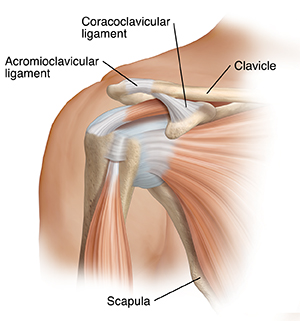
A shoulder separation happens when part of the shoulder blade (scapula) separates from the collarbone (clavicle). A separation is not the same as a dislocation. With a dislocation, the bone pulls out of a joint. Shoulder separation is common, especially in active people. It’s most often caused by an injury that damages the ligaments around the shoulder joint. These ligaments are called the acromioclavicular ligaments and the coracoclavicular ligaments. They attach 2 areas of the shoulder blade to the collarbone and may be stretched, partially torn, or completely torn. The shoulder blade may move downward from the weight of your arm.
Types of treatment
Your treatment may depend on how serious the injury is. Treatment may include:
-
Resting the joint with a sling or other support
-
Physical therapy
-
Using cold packs on the area
-
Pain medicines
Your healthcare provider may show you special exercises to do. These will help rebuild your strength, flexibility, and range of motion as you heal. You’ll likely need to start these as soon as your pain starts to go away.
You may not need any other treatment. If your injury is more severe, you may need surgery, especially if you are an athlete. Your healthcare provider may first want to see if your AC (acromioclavicular) joint heals on its own before trying surgery.
Surgeons have a number of ways to bring your collarbone back into alignment with the scapula. They might fix the bones together using screws. Or the ligaments that support your AC joint may be repaired. A ligament from another part of your body may be used to repair it.
Recovering from shoulder separation
Most people will get back all or almost all normal arm and shoulder function, but a slight deformity may remain. If you have a mild shoulder separation, you may totally recover within a few weeks. More severe injuries may need more time to heal.
Your healthcare provider will give you directions about when you can go back to your normal activities. This may take a few weeks or longer. You may need to protect your joint from injury for a while. This is so your ligaments can fully heal. Athletes may need longer recovery times.
Be sure to follow all your healthcare provider’s directions. Make sure to do exercises as advised. This will make it more likely for you to recover fully.
Possible complications of shoulder separation
A small number of people have pain in their AC joint for weeks or months after their injury. This may be because of abnormal contact between the bones. Arthritis can also develop in the joint because of your injury. You may need surgery to treat these symptoms.
Preventing shoulder separation
You may be able to lower your risk for shoulder separation by taking basic safety precautions. Make sure to always wear a seatbelt while driving or riding in a car. Use the protective gear for your sport.
When to call your healthcare provider
Call your healthcare provider right away if you have any of the following occur:
-
Fever of 100.4°F (38°C) or higher, or as directed by your healthcare provider
-
Chills
-
Pain that gets worse
-
Symptoms that don’t get better, or get worse
-
You can't move your arm at all
-
Numbness in your arm or hand
-
Signs of poor blood flow, such as a cool, pale hand
Online Medical Reviewer: L Renee Watson MSN RN
Online Medical Reviewer: Raymond Turley Jr PA-C
Online Medical Reviewer: Thomas N Joseph MD
Date Last Reviewed: 12/01/2022
© 2000-2026 The StayWell Company, LLC. All rights reserved. This information is not intended as a substitute for professional medical care. Always follow your healthcare professional's instructions.
Need Help? We're Here for You
Our Member Services team is here to help you understand your benefits, find care, or resolve concerns.
1-800-510-9132
Call NC Quitline
Need support to quit smoking, vaping, or to quit other nicotine products? You can receive support including medicines free of charge:
1-800-784-8669
Schedule Transportation
Need transportation to a doctor's office, pharmacy, or other covered healthcare service? Contact us to arrange your ride.
1-800-510-9132
Provider Directory
Need to find a provider like a Primary Care Physician, Specialist, OB/GYN, or a Psychiatrist?
Provider DirectoryRelated Articles
Electrothermal Catheter Therapy: After the Procedure
Learn what to expect after electrothermal catheter therapy, both in the hospital and when you're at home.
Surgery for Shoulder Impingement
For many people, nonsurgical treatments are enough to ease shoulder impingement symptoms. But if these treatments haven’t worked, surgery may be an option.
Understanding Ankle Replacement Surgery
Ankle replacement surgery is a procedure to treat arthritis of the ankle joint. The damaged ankle joint is replaced with an artificial implant.
Hip Arthroscopy: Repairing Chondral Damage
Arthroscopy can be used to repair loose or missing cartilage in the hip joint. Learn more about this surgery and how it is done.