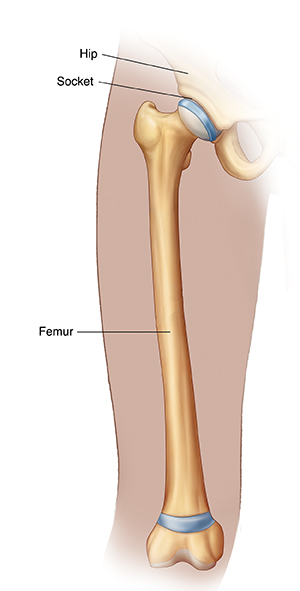
A femoral osteotomy is a type of surgery. Your child may need it if they have a problem with their hip joint and femur. The femur is the thighbone that joins the pelvis to the knee. During this surgery, a small part of the femur is cut out so the bone fits better into the hip socket.
How to say it
FEHM-uh-ruhl ohs-tee-OHT-uh-mee
Why a femoral osteotomy is done
This surgery is most often done in children who are born with a hip abnormality, such as hip dislocation (developmental dysplasia of the hip). Your child’s health care provider may advise it when the top of the femur does not fit well into the hip socket. Your child’s pelvic and femur bones may not work together the right way. The femur may be angled too far forward or backward. Your child may walk with inward- or outward-facing toes.
Your child may also have this surgery if they have:
-
Legs that are of different lengths.
-
Cerebral palsy. A child with this condition can have severe muscle spasms that can cause the hips to come out of their sockets.
-
A broken bone that didn’t heal well.
A femoral osteotomy can ease pain in the hip joint. It can also help your child run and walk more normally. And it can correct inward- or outward-facing toes.
The surgery is often done to delay a joint replacement.
How femoral osteotomy is done
This procedure is done in a hospital. During the procedure:
-
Your child is placed on their back on an operating table.
-
Your child is given medicine to make them fall asleep. Your child won’t feel pain during the surgery.
-
A surgeon makes a cut along your child’s femur near the hip joint.
-
The surgeon uses X-rays to confirm where they will cut out a small part of the femur.
-
The surgeon cuts the femur with a tool called an osteotome.
-
The surgeon puts the femur in the right place. If needed, they turn it so the top part of it fits as it should into the hip socket.
-
The surgeon attaches a plate with screws or pins to the top of the femur. The plate helps align the femur in the hip socket and keeps the bone in place as it heals.
-
The surgeon closes up the incision.
-
Your child may be put in a spica cast to maintain correct hip alignment.
After femoral osteotomy
Your child should be able to put weight on the leg 4 to 6 weeks after the surgery. This is the goal if your child was walking before the surgery. Your child may need more help getting around at first.
Your child will also need to do physical therapy after the surgery. In some cases, the metal plate may need to be removed at some point in the future.
Risks of femoral osteotomy
-
Infection
-
Bleeding
-
Bone that doesn’t heal as it should
-
Nerve damage
-
Arthritis
-
Broken bone (fracture)
Featured in
Author: Semko, Laura
Online Medical Reviewer: Kenny Turley PA-C
Online Medical Reviewer: L Renee Watson MSN RN
Online Medical Reviewer: Thomas N Joseph MD
Date Last Reviewed: 03/01/2025
© 2000-2026 The StayWell Company, LLC. All rights reserved. This information is not intended as a substitute for professional medical care. Always follow your healthcare professional's instructions.
Need Help? We're Here for You
Our Member Services team is here to help you understand your benefits, find care, or resolve concerns.
1-800-510-9132
Call NC Quitline
Need support to quit smoking, vaping, or to quit other nicotine products? You can receive support including medicines free of charge:
1-800-784-8669
Schedule Transportation
Need transportation to a doctor's office, pharmacy, or other covered healthcare service? Contact us to arrange your ride.
1-800-510-9132
Provider Directory
Need to find a provider like a Primary Care Physician, Specialist, OB/GYN, or a Psychiatrist?
Provider DirectoryRelated Articles
When Your Child Needs Surgery: Anesthesia
During surgery, your child will receive anesthesia. This is medicine that causes your child to relax or fall asleep, and not feel pain during surgery. See below for more information about different types of anesthesia.
When Your Child Needs Orthopedic Surgery
Your child is having bone or joint surgery. The healthcare provider who does this surgery is called an orthopedic surgeon. This sheet can help you prepare your child and learn what to expect.
During Cervical Disk Surgery
During surgery, your surgeon may remove all or part of the disk (diskectomy). To reach the cervical spine, they may make an incision in the front (anterior) or the back (posterior) of your neck. Learn more about these 2 approaches.
Using Play to Help Your Child Cope With Surgery
Children use play to express emotion, learn, and interact. When getting ready for surgery, play can help children understand and cope with their hospital experience.


