Meniscal transplant surgery is done to replace a small piece of missing or damaged cartilage in the knee. It's replaced with one from a cadaver donor.
What is the meniscus?
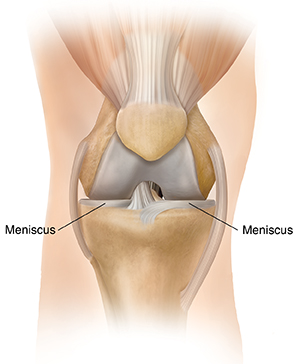
Your knee has two wedge-shaped pieces of cartilage. They lie on each side of your knee. Each piece is called a meniscus. They act as shock absorbers between your thighbone (femur) and your shinbone (tibia). The rubbery menisci help protect the ends of your bones as they move together.
A twisting injury may badly damage your meniscus. It may need to be removed if the damage is bad enough. Without this cushion, the ends of your bones may start to rub together. This can cause knee pain and arthritis over time.
Why meniscal transplant surgery is done
Meniscal transplant surgery may be done if your meniscus was taken out in a past surgery. With no meniscus, you may get knee pain and arthritis of the knee. Replacing it may give you pain relief. It may also help prevent arthritis. This surgery is less invasive than knee replacement surgery. But it may not be an option if you already have arthritis of your knee.
Meniscal transplant surgery may be a choice if you:
-
Are age 45 or younger and physically active.
-
Are missing a large part of your meniscus.
-
Have a large meniscus tear that can’t be repaired.
-
Have severe or ongoing knee pain with activity.
-
Have no or only a small amount of arthritis.
-
Have a knee with normal alignment and stable ligaments.
-
Are not obese.
How meniscal transplant surgery is done
Your surgery will be done by an orthopedic surgeon. This is a surgeon who specializes in treating bone, muscle, joint, and tendon problems.
The surgery can be done in several ways. The surgeon will make one or more small cuts (incisions) through the skin and muscle of your knee. The surgeon will put a very small camera through this cut. This is used to help guide the surgery. Any remaining meniscus is removed with very small tools put through the cut. The surgeon will stitch the donated meniscus into the joint. Screws or other devices may be used to hold it in place.
Risks of meniscal transplant surgery
All surgery has some risks. The risks of this surgery include:
-
Stiffness of the joint after surgery (more common).
-
Incomplete healing and need for another surgery.
-
Too much bleeding.
-
Infection.
-
Damage to nearby nerves.
-
Problems from anesthesia.
-
An infection from the donated tissue (very rare).
Your own risks may be different based on your age, overall health, and other things. Ask your surgeon about the risks that most apply to you.
Featured in
Online Medical Reviewer: Raymond Turley Jr PA-C
Online Medical Reviewer: Stacey Wojcik MBA BSN RN
Online Medical Reviewer: Thomas N Joseph MD
Date Last Reviewed: 04/01/2025
© 2000-2026 The StayWell Company, LLC. All rights reserved. This information is not intended as a substitute for professional medical care. Always follow your healthcare professional's instructions.
Need Help? We're Here for You
Our Member and Recipient Services Team is here to help you understand your benefits, find care, or resolve concerns.
800-510-9132
Call NC Quitline
Need support to quit smoking, vaping, or to quit other nicotine products? You can receive support including medicines free of charge:
800-784-8669
Schedule Transportation
Need transportation to a doctor's office, pharmacy, or other covered healthcare service? Contact us to arrange your ride.
800-510-9132
Provider Directory
Need to find a provider like a Primary Care Physician, Specialist, OB/GYN, or a Psychiatrist?
Provider DirectoryRelated Articles
Kneecap Surgery: Removing Damaged Cartilage
Surgery may be used when pain severely limits your activities. Or it may be done when a rehab program or other nonsurgical treatments just are not helping enough. Some procedures may be done using arthroscopy. This method uses tiny incisions and special instruments to look and work inside the knee joint. Other procedures need open surgery.
Foot Surgery: Curled Fifth Toe
A curled fifth toe is most often inherited. When the fifth toe curls inward, it moves under the next toe. Then the nail of the curled toe starts to face outward. As a result, you may bear weight on the side of your toe instead of the bottom. This can cause corns and painful nails. There are many nonsurgical treatments available. But if these are not effective, surgery is a choice.
Surgery for Shoulder Impingement: Your Experience
Surgery can help free up space in your shoulder joint. This relieves symptoms of impingement. Prepare for surgery as instructed. If you don’t, your surgery may have to be rescheduled. Your healthcare provider will give you instructions for recovering at home. If you have any questions, be sure to get them answered.
Surgery for Shoulder Impingement
For many people, nonsurgical treatments are enough to ease shoulder impingement symptoms. But if these treatments haven’t worked, surgery may be an option.


