How it can help you
Lumbar microsurgery uses a smaller cut (incision) than traditional lumbar surgery. A smaller cut helps you heal faster. This surgery often eases leg pain (sciatica) from the hip down to the foot. It also:
-
Reduces leg numbness
-
Improves leg strength
-
Sometimes eases back pain (after the pain from surgery is gone)
In some cases, a larger cut may be needed.
Removing bone
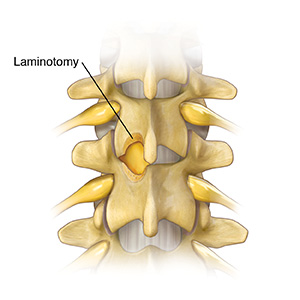
During a microdecompression, bone is taken out. First, a small part of the lamina is removed. It is taken from the vertebrae above and below the pinched nerve. Removing part of the lamina is called a laminotomy. Taking out all the lamina is called a laminectomy. If there is no disk problem, the small opening made by this process may take pressure off the nerve. But most often, more bone, ligaments, or both are pressing on a nerve. This bone and the ligaments are also taken out.
Removing disk
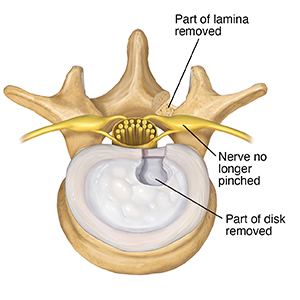
During a microdiskectomy, some disk is removed. In most cases, a laminotomy must first be done to expose the damaged disk. The part of the disk outer wall and soft center that presses on the nerve can then be taken out. Any disk matter that is loose or that may cause problems in the future is also taken out. There is often enough disk still there to cushion the vertebrae.
Featured in
Online Medical Reviewer: Anne Fetterman RN BSN
Online Medical Reviewer: Luc Jasmin MD
Online Medical Reviewer: Raymond Kent Turley BSN MSN RN
Date Last Reviewed: 03/01/2024
© 2000-2026 The StayWell Company, LLC. All rights reserved. This information is not intended as a substitute for professional medical care. Always follow your healthcare professional's instructions.
Need Help? We're Here for You
Our Member and Recipient Services Team is here to help you understand your benefits, find care, or resolve concerns.
800-510-9132
Call NC Quitline
Need support to quit smoking, vaping, or to quit other nicotine products? You can receive support including medicines free of charge:
800-784-8669
Schedule Transportation
Need transportation to a doctor's office, pharmacy, or other covered healthcare service? Contact us to arrange your ride.
800-510-9132
Provider Directory
Need to find a provider like a Primary Care Physician, Specialist, OB/GYN, or a Psychiatrist?
Provider DirectoryRelated Articles
Surgery for Shoulder Impingement
For many people, nonsurgical treatments are enough to ease shoulder impingement symptoms. But if these treatments haven’t worked, surgery may be an option.
Understanding Ankle Replacement Surgery
Ankle replacement surgery is a procedure to treat arthritis of the ankle joint. The damaged ankle joint is replaced with an artificial implant.
Understanding Leg Amputation: Surgery for a Medical Condition
This surgery removes part or all your leg. It is done because tissue in the leg is diseased and can't be healed. Or it may be needed to prevent the disease from spreading farther into your body. The goal of the surgery is to restore your ability to function. This is because removing the diseased part of your leg can improve your total health.
Carpal Tunnel Release Surgery
If you have severe carpal tunnel syndrome, you may have carpal tunnel release surgery.


