Wrist arthroscopy is used for diagnosis and treatment. It works best for showing ligament tears, damage to the triangular fibrocartilage complex (TFCC), or joint cartilage. Since the wrist is a very small joint, the surgeon uses a special arthroscope.
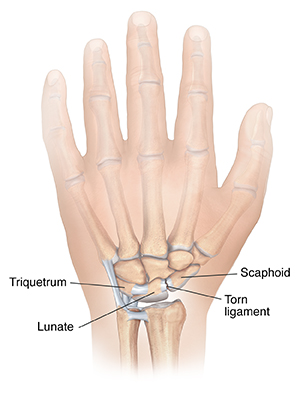
Ligament tears
The ligaments between the bones of the wrist can tear. This most often happens between the lunate and scaphoid bones or the lunate and triquetrum bones. Such tears can cause pain, swelling, and a weak grip. With a full tear, the bones may pull apart and limit motion. To perform repairs, your surgeon may shift to open surgery.
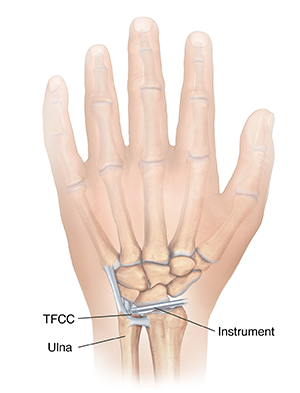
TFCC damage
Injury or constant use over time can cause a tear in the TFCC (triangular fibrocartilage complex). During surgery, the tear may be shaved off or repaired. Bone or cartilage fragments may be removed. After healing, you should be able to move your wrist with greater ease and less pain.
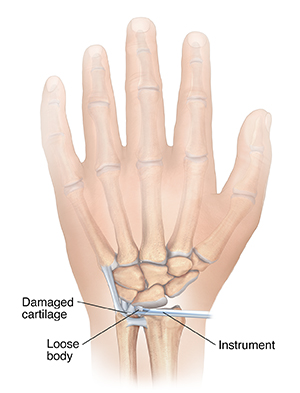
Cartilage damage
If you have wearing down of the cartilage (arthritis), your surgeon will shave off or smooth the worn area. Bone or cartilage fragments that have chipped off in the joint (loose bodies) will be removed. The removal of loose bodies can help restore smooth, pain-free wrist movement.
Online Medical Reviewer: L Renee Watson MSN RN
Online Medical Reviewer: Raymond Turley Jr PA-C
Online Medical Reviewer: Thomas N Joseph MD
Date Last Reviewed: 12/01/2022
© 2000-2026 The StayWell Company, LLC. All rights reserved. This information is not intended as a substitute for professional medical care. Always follow your healthcare professional's instructions.
Need Help? We're Here for You
Our Member and Recipient Services Team is here to help you understand your benefits, find care, or resolve concerns.
800-510-9132
Call NC Quitline
Need support to quit smoking, vaping, or to quit other nicotine products? You can receive support including medicines free of charge:
800-784-8669
Schedule Transportation
Need transportation to a doctor's office, pharmacy, or other covered healthcare service? Contact us to arrange your ride.
800-510-9132
Provider Directory
Need to find a provider like a Primary Care Physician, Specialist, OB/GYN, or a Psychiatrist?
Provider DirectoryRelated Articles
Treating a Wrist Fracture
A treatment called reduction may help your wrist heal better. The goal of reduction is to get your wrist bones as close as possible to how they were before the fracture. Learn more about this treatment and what the recovery process is like.
Hip Arthroscopy: Removing Loose Bodies
Arthroscopy may be done to remove loose bodies in the hip through small incisions. Learn more about this procedure.
Understanding Elbow Fracture Open Reduction and Internal Fixation (ORIF)
Open reduction and internal fixation (ORIF) is a type of treatment to fix a broken bone. It puts the pieces of a broken bone back together so they can heal.
Hip Arthroscopy: Repairing Femoroacetabular Impingement
When excess bone forms on the edge of the ball or the socket of the hip, it's called FAI (femoroacetabular impingement). This can cause pain and limit movement. Arthroscopy can fix FAI. It uses small incisions and special tools. Read on to learn more.


