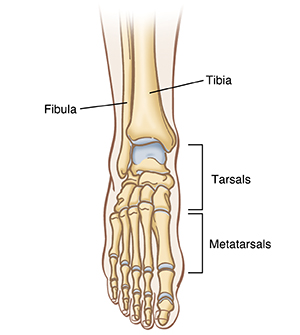
You have a broken bone (fracture) in your foot. This will cause pain, swelling, and often bruising. It will usually take about 4 to 8 weeks to heal. A foot fracture may be treated with a special shoe, splint, cast, or boot.
Home care
Follow these guidelines when caring for yourself at home:
-
You may be given a splint, cast, shoe, or boot to keep the injured area from moving. Unless you were told otherwise, use crutches or a walker. Don’t put weight on the injured foot until your health care provider says you can do so. (You can rent crutches or a walker at many drugstores and surgical or orthopedic supply stores.) Don’t put weight on a splint, or it may break.
-
Keep your leg elevated to reduce pain and swelling. When you sleep, put a pillow under the injured leg. When you sit, support the injured leg so it's above your heart. This is very important during the first 2 days (48 hours).
-
Put an ice pack on the injured area. Do this for 20 minutes every 1 to 2 hours the first day for pain relief. You can make an ice pack by wrapping a plastic bag of ice cubes in a thin towel. As the ice melts, be careful that the splint, cast, boot, or shoe doesn’t get wet. You can place the ice pack directly over the splint or cast. Unless you're told otherwise, you can open the boot or shoe to apply the ice pack. Keep using the ice pack 3 or 4 times a day for the next 2 days. Then use the ice pack as needed to ease pain and swelling.
-
Keep the splint, cast, boot, or shoe dry. When you bathe, protect it with a large plastic bag, rubber-banded at the top end. If a fiberglass splint or cast or boot gets wet, you can dry it with a hair dryer on a cool setting. Unless you're told otherwise, you can take off the boot or shoe to bathe.
-
You may use acetaminophen or ibuprofen to control pain, unless another pain medicine was prescribed. If you have chronic liver or kidney disease, talk with your health care provider before using these medicines. Also talk with your provider if you’ve had a stomach ulcer or gastrointestinal bleeding.
-
Don’t put creams or objects under the cast if you have itching.
Follow-up care
Follow up with your health care provider as advised. This is to make sure the bone is healing the way it should. If you were given a splint, it may be changed to a cast or boot at your follow-up visit.
X-rays may be taken. You will be told of any new findings that may affect your care.
When to seek medical advice
Contact your health care provider right away if:
-
The cast or splint cracks.
-
The plaster cast or splint becomes wet or soft.
-
The fiberglass cast or splint stays wet for more than 24 hours.
-
The cast has a bad odor, or wound fluid stains the cast.
-
Tightness or pain under the cast or splint gets worse.
-
Your toes become swollen, cold, blue, numb, or tingly.
-
You can’t move your toes.
-
Skin around the cast or splint becomes red or swollen.
-
You have a fever of 100.4ºF (38ºC) or higher, or as directed by your provider.
-
You have chills.
Online Medical Reviewer: Raymond Turley Jr PA-C
Online Medical Reviewer: Stacey Wojcik MBA BSN RN
Online Medical Reviewer: Thomas N Joseph MD
Date Last Reviewed: 03/01/2025
© 2000-2026 The StayWell Company, LLC. All rights reserved. This information is not intended as a substitute for professional medical care. Always follow your healthcare professional's instructions.
Need Help? We're Here for You
Our Member and Recipient Services Team is here to help you understand your benefits, find care, or resolve concerns.
800-510-9132
Call NC Quitline
Need support to quit smoking, vaping, or to quit other nicotine products? You can receive support including medicines free of charge:
800-784-8669
Schedule Transportation
Need transportation to a doctor's office, pharmacy, or other covered healthcare service? Contact us to arrange your ride.
800-510-9132
Provider Directory
Need to find a provider like a Primary Care Physician, Specialist, OB/GYN, or a Psychiatrist?
Provider DirectoryRelated Articles
Understanding Shoulder Impingement Syndrome
Shoulder impingement syndrome is a problem with the shoulder joint. It occurs when certain parts in the joint swell and are pinched. This can cause nagging pain and problems with moving the arm.
Back Sprain or Strain
Learn how to care for your back sprain or strain at home.
Tendonitis
When a tendon becomes inflamed, it is called tendonitis. This can occur from overuse, injury, or infection. Learn how to care for tendonitis at home.
Finger Dislocation
How to care for your finger after a dislocation.


