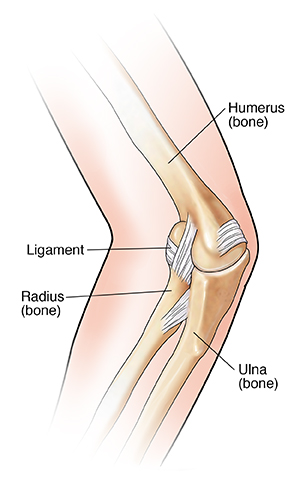
The elbow is a joint made up of three bones held in place by strong bands of tissue (ligaments). One ligament is looser in young children than in adults. As a result, soft tissue may become trapped between the bones in a child's elbow joint. The medical name for this injury is radial head subluxation. It often happens when a child is lifted or pulled by one arm, and the elbow partly dislocates.
Risk factors
Children under age 4 are most likely to have a radial head subluxation. As children grow older, their elbow ligaments become stronger. For that reason, this injury rarely happens after age 6.
When to go to the emergency room (ER)
A radial head subluxation causes sudden pain. In addition, your child won't be able to flex their elbow. The injured arm is likely to hang loosely at your child's side, and they won't move or use it. If your child's healthcare provider can't see them right away, go to the nearest emergency room (ER).
What to expect in the ER
A healthcare provider will examine the injured arm. An X-ray may be taken. The provider will then gently move the joint to release the trapped tissue. Your child can sit on your lap facing the provider while this is done. It's likely to hurt for just a minute. Your child will be fine once the parts of the joint are all back in place. Most often, no other care is needed.
Preventing a pulled elbow
These tips can help prevent radial head subluxation in a child:
-
Lift your child under the arms—not by the hands or wrists.
-
Don`t swing your child by the arms.
-
Don`t pull your child by the hand or arm, even when you`re in a hurry.
Online Medical Reviewer: L Renee Watson MSN RN
Online Medical Reviewer: Raymond Turley Jr PA-C
Online Medical Reviewer: Thomas N Joseph MD
Date Last Reviewed: 10/01/2024
© 2000-2026 The StayWell Company, LLC. All rights reserved. This information is not intended as a substitute for professional medical care. Always follow your healthcare professional's instructions.
Need Help? We're Here for You
Our Member Services team is here to help you understand your benefits, find care, or resolve concerns.
1-800-510-9132
Call NC Quitline
Need support to quit smoking, vaping, or to quit other nicotine products? You can receive support including medicines free of charge:
1-800-784-8669
Schedule Transportation
Need transportation to a doctor's office, pharmacy, or other covered healthcare service? Contact us to arrange your ride.
1-800-510-9132
Provider Directory
Need to find a provider like a Primary Care Physician, Specialist, OB/GYN, or a Psychiatrist?
Provider DirectoryRelated Articles
Shoulder Pain With Uncertain Cause
Shoulder pain can have many causes. Pain often comes from the structures that surround the shoulder joint. Pain can also come from cartilage in the joint.
Pinched Nerve in the Neck
Pinched nerve in the neck (cervical radiculopathy) is caused when the nerve that goes from the spinal cord to the arm is irritated or has pressure on it. This may be caused by a bulging spinal disk or a narrowing of the spinal joint because of arthritis.
Sacroiliitis
Sacroiliitis is when one or both sacroiliac joints are hurt or inflamed. It can make small movements of the lower back and pelvis very painful. Learn how to care for yourself at home.
Understanding Bone Bruise (Bone Contusion)
A bone bruise is an injury to a bone that is less severe than a bone fracture. Bone bruises are fairly common. They can happen to people of all ages. Any type of bone in your body can get a bone bruise.