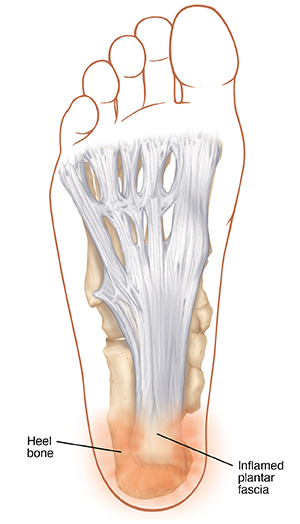
Your heel is the back part of your foot. A band of tissue called the plantar fascia connects the heel bone to the bones in the ball of your foot. Nerves run from the heel up the inside of your ankle and into your leg. When you feel pain in the bottom of your heel, the plantar fascia may be inflamed. Overuse, Achilles tightness, and excess body weight can cause the tissue to tear or pull away from the bone. Sometimes the inflamed plantar fascia also irritates a nerve, causing more pain.
What causes heel pain?
Wearing shoes with poor cushioning can irritate the tissue in your heel (plantar fascia). Being overweight or standing for long periods can also irritate the tissue. Running, walking, tennis, and other sports that put stress on the heels can cause tiny tears in the tissue. If your lower leg muscles are tight, this is more likely to happen. A tight Achilles tendon will also add to heel pain.
Symptoms
You may feel pain on the bottom or on the inside edge of your heel. The pain may be sharp when you get out of bed or when you stand up after sitting for a while. You may feel a dull ache in your heel after you’ve been standing for a long time on a hard surface. Running can also cause a dull ache.
Preventing future problems
To prevent future heel pain, wear shoes with well-cushioned heels. And do exercises prescribed by your doctor to stretch the Achilles tendon and the muscles in the lower leg.
Online Medical Reviewer: L Renee Watson MSN RN
Online Medical Reviewer: Raymond Turley Jr PA-C
Online Medical Reviewer: Thomas N Joseph MD
Date Last Reviewed: 05/01/2025
© 2000-2026 The StayWell Company, LLC. All rights reserved. This information is not intended as a substitute for professional medical care. Always follow your healthcare professional's instructions.
Need Help? We're Here for You
Our Member and Recipient Services Team is here to help you understand your benefits, find care, or resolve concerns.
800-510-9132
Call NC Quitline
Need support to quit smoking, vaping, or to quit other nicotine products? You can receive support including medicines free of charge:
800-784-8669
Schedule Transportation
Need transportation to a doctor's office, pharmacy, or other covered healthcare service? Contact us to arrange your ride.
800-510-9132
Provider Directory
Need to find a provider like a Primary Care Physician, Specialist, OB/GYN, or a Psychiatrist?
Provider DirectoryRelated Articles
Biceps Tendon Rupture
A biceps tendon connects the biceps muscle to the bones at the shoulder and elbow. This tendon can fray from heavy use over time and it can completely rupture or tear from injury, such as from lifting a heavy object.
Joint Dislocation
You have a joint dislocation. This happens when a strong force is applied to the joint, tearing ligaments and forcing the bones out of place. Often no bones are broken. But the nearby nerves and blood vessels can be damaged.
Understanding Carpal Tunnel Syndrome
Carpal tunnel syndrome leads to tingling and numbness of the hand and wrist. In time, the condition can make even simple tasks hard to do.
Understanding a Clavicle Fracture
A fracture of the clavicle is a broken collarbone. Clavicle fractures occur most often along the middle of the bone. Depending on how badly the bone is broken, healing may take a few months or longer.


