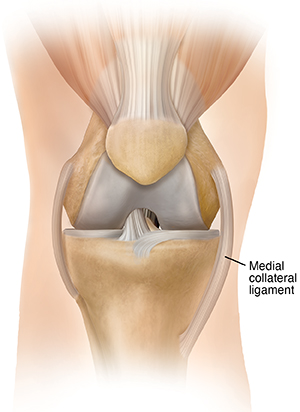
The knee is a complex joint where the thighbone (femur) meets the shinbone (tibia). Strong tissues called ligaments connect these bones together. Ligaments also keep the bones aligned so the knee bends only how it is supposed to. The medial collateral ligament (MCL) runs across the knee joint on the medial (inner) side of the leg. Injury to this ligament may be very painful. The knee may also not work the way it should.
Causes of an MCL sprain
An MCL sprain often happens when the knee joint is pushed beyond its normal range of motion. It's most common during a blow to the knee from the outside, pushing the knee inward. It may also happen if the knee is forced into a twist. These movements stretch and tear the MCL. Other parts of the knee may be damaged along with the MCL.
Knee sprains are graded by the amount of ligament damage:
-
Grade 1. There is mild damage to the ligament, but the knee joint is still stable.
-
Grade 2. The ligament is stretched and loose. This is called a partial tear.
-
Grade 3. There is a complete tear to the ligament, and the knee joint is unstable.
Symptoms of an MCL sprain
These include:
-
Knee pain.
-
Knee swelling.
-
Limited range of motion of the joint.
-
Wobbly or unstable feeling in the joint.
Treatment for an MCL sprain
Treatment will depend on the severity of the sprain and whether there is damage to other parts of the knee. Choices often include:
-
Rest. This allows the knee to heal. Don't do any activities that stress the knee. Crutches, a knee brace, or both may also be recommended for a short time.
-
Cold packs and elevation of the knee. These help reduce swelling and relieve pain.
-
Compression. The knee may be wrapped with a bandage to help reduce swelling.
-
Medicines. These help relieve pain and swelling.
-
Exercises. These help improve the knee’s stability, strength, and range of motion.
If the injury is severe or several parts of the joint are involved, surgery may be a choice. Surgery repairs the MCL and any other damaged structures.
When to contact your doctor
Contact your health care provider right away if you have:
-
Pain, swelling, or instability that doesn’t get better with treatment or gets worse.
-
New symptoms.
Author: Michels, Karen
Online Medical Reviewer: Raymond Turley Jr PA-C
Online Medical Reviewer: Stacey Wojcik MBA BSN RN
Online Medical Reviewer: Thomas N Joseph MD
Date Last Reviewed: 04/01/2025
© 2000-2026 The StayWell Company, LLC. All rights reserved. This information is not intended as a substitute for professional medical care. Always follow your healthcare professional's instructions.
Need Help? We're Here for You
Our Member Services team is here to help you understand your benefits, find care, or resolve concerns.
1-800-510-9132
Call NC Quitline
Need support to quit smoking, vaping, or to quit other nicotine products? You can receive support including medicines free of charge:
1-800-784-8669
Schedule Transportation
Need transportation to a doctor's office, pharmacy, or other covered healthcare service? Contact us to arrange your ride.
1-800-510-9132
Provider Directory
Need to find a provider like a Primary Care Physician, Specialist, OB/GYN, or a Psychiatrist?
Provider DirectoryRelated Articles
Finger Dislocation
How to care for your finger after a dislocation.
Open Hand Fracture (Adult)
You have a fracture, or broken bone, in your hand. An open fracture means that the bone goes through the skin. Or it may mean there is a wound in the skin that goes as deep as the fractured bone. Because of this, there is a risk of infection to the skin or bone. Here's how to care for the fracture as it heals.
Possible Wrist Fracture
You are very sore over a bone in your wrist. This could be a sign of a hairline fracture, or break, even though no fracture was seen on the X-ray. Read on to learn how to care for yourself at home.
Thoracic Spine Strain
Learn how to care for a thoracic spine strain.


