A joint is a place where two bones meet. The knee is called a hinge joint. This joint is formed where the thighbone (femur) meets the shinbone (tibia). A healthy knee joint bends freely. Knee osteoarthritis is a condition where parts of the knee joint wear out. This can lead to pain, stiffness, and limited movement.
What is osteoarthritis?
Every joint contains a smooth tissue called cartilage. Cartilage cushions the ends of bones and helps bones in a joint glide smoothly against each other. Knee osteoarthritis occurs when cartilage in the knee joint starts to break down and wear away. Bones may become exposed and rub together. The cartilage may become irritated and rough. This prevents smooth movement of the joint and can lead to pain.
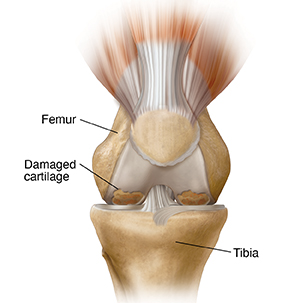
Causes of osteoarthritis of the knee
Causes can include:
-
Wear and tear from normal use over time, especially in older adults.
-
Repeated stress or overuse of the knee during sports or work activities.
-
Being overweight. This increases stress on the knee joint.
-
Misalignment of the knee joint.
-
Injury to the knee.
-
Inflammatory arthritis. This can cause a secondary osteoarthritis.
-
Gout or pseudogout. This can cause a secondary osteoarthritis.
-
Genetics. Your genes can affect when osteoarthritis starts and how severe it is.
Symptoms of osteoarthritis of the knee
Common symptoms include:
-
Pain and swelling around the joint. The pain and swelling get worse with activity and better with rest.
-
A grinding sound when you move the knee.
-
Reduced knee movement.
-
Knee stiffness. This is often worse first thing in the morning.
Treating osteoarthritis of the knee
Osteoarthritis is a long-term condition. Treatment is done to manage symptoms. It may include:
-
Medicines taken by mouth to help relieve pain and swelling.
-
Injections of medicine into the joint to help relieve symptoms for a time.
-
A weight-loss plan for people who are overweight.
-
A plan of physical therapy and exercises. These can improve the strength and flexibility of the muscles around the knee.
-
Heat or cold therapy to help relieve pain and stiffness.
-
Devices that help with movement, such as a cane or a walker.
-
Devices that make daily tasks easier, such as raised toilet seats or shower bars.
If other treatments don’t help to relieve symptoms, you may need surgery. This is done to replace the joint. During this surgery, the damaged knee joint is removed. An artificial knee joint is then put into place. This can help relieve pain and stiffness and restore movement of the knee.
When to call your doctor
Contact your doctor right away if you have:
-
A fever of 100.4°F (38°C) or higher, or as directed by your doctor.
-
Symptoms that don’t get better with prescribed medicines or that get worse.
-
New symptoms.
Author: Michels, Karen
Online Medical Reviewer: Diane Horowitz MD
Online Medical Reviewer: Raymond Kent Turley BSN MSN RN
Online Medical Reviewer: Rita Sather RN
Date Last Reviewed: 06/01/2025
© 2000-2026 The StayWell Company, LLC. All rights reserved. This information is not intended as a substitute for professional medical care. Always follow your healthcare professional's instructions.
Need Help? We're Here for You
Our Member Services team is here to help you understand your benefits, find care, or resolve concerns.
1-800-510-9132
Call NC Quitline
Need support to quit smoking, vaping, or to quit other nicotine products? You can receive support including medicines free of charge:
1-800-784-8669
Schedule Transportation
Need transportation to a doctor's office, pharmacy, or other covered healthcare service? Contact us to arrange your ride.
1-800-510-9132
Provider Directory
Need to find a provider like a Primary Care Physician, Specialist, OB/GYN, or a Psychiatrist?
Provider DirectoryRelated Articles
Understanding Trochanteric Bursitis
The trochanteric bursa is found on the hip joint. Inflammation of this bursa is called trochanteric bursitis.
Joint Dislocation
You have a joint dislocation. This happens when a strong force is applied to the joint, tearing ligaments and forcing the bones out of place. Often no bones are broken. But the nearby nerves and blood vessels can be damaged.
Understanding Cervical Radiculopathy
Cervical radiculopathy is irritation or inflammation of a nerve root in the neck. It causes neck pain and other symptoms that may spread into the chest or down the arm.
Understanding Ankle Sprain
When ankle ligaments are stretched to the point of pain and injury, it's called an ankle sprain. A sprain can tear the ligaments. These tears can be very small but still cause pain.