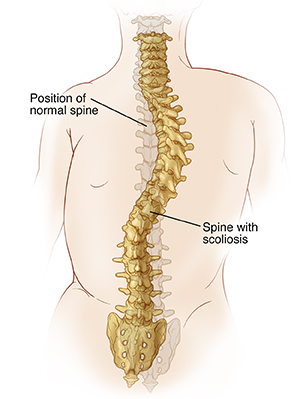
Scoliosis is a problem that makes the spine curve and twist from side to side. It's most often found in girls in their early teens. But boys can have it, too. No one is sure what causes scoliosis. But we do know that scoliosis is not caused by things like carrying heavy bags or playing sports. If someone in your family (like a parent or a sibling) has scoliosis, you may be more likely to have it, too.
What are the signs?
The signs of scoliosis may include:
-
One shoulder higher than the other.
-
One shoulder blade sticking out farther than the other.
-
An uneven waistline.
-
One hip higher than the other.
-
Hems hanging unevenly on you.
-
One side of the rib cage higher than the other when bending forward.
These signs often appear slowly as you grow. You and your parents may not even notice them. For this reason, schools in many states have screening programs to check for scoliosis. These programs help find scoliosis early and keep it from causing problems later.
A note to parents
Here are some suggestions:
-
Hearing that your child has scoliosis can be upsetting. But remember that mild cases may not need treatment. If your child's scoliosis is severe or getting worse, it can be treated.
-
Go to all your child’s appointments. Ask questions and be sure you understand the health care provider’s instructions.
-
Become informed about scoliosis. Try the library or do a search on the internet.
-
Form a team with your child and their provider. Be your child’s coach and biggest fan.
-
Know that each child is different. Your child’s provider will choose the treatment that is best for your child’s spine.
Online Medical Reviewer: Marianne Fraser MSN RN
Online Medical Reviewer: Raymond Turley Jr PA-C
Online Medical Reviewer: Vinita Wadhawan Researcher
Date Last Reviewed: 01/01/2025
© 2000-2026 The StayWell Company, LLC. All rights reserved. This information is not intended as a substitute for professional medical care. Always follow your healthcare professional's instructions.
Need Help? We're Here for You
Our Member and Recipient Services Team is here to help you understand your benefits, find care, or resolve concerns.
800-510-9132
Call NC Quitline
Need support to quit smoking, vaping, or to quit other nicotine products? You can receive support including medicines free of charge:
800-784-8669
Schedule Transportation
Need transportation to a doctor's office, pharmacy, or other covered healthcare service? Contact us to arrange your ride.
800-510-9132
Provider Directory
Need to find a provider like a Primary Care Physician, Specialist, OB/GYN, or a Psychiatrist?
Provider DirectoryRelated Articles
Joint Dislocation
You have a joint dislocation. This happens when a strong force is applied to the joint, tearing ligaments and forcing the bones out of place. Often no bones are broken. But the nearby nerves and blood vessels can be damaged.
Understanding Carpal Tunnel Syndrome
Carpal tunnel syndrome leads to tingling and numbness of the hand and wrist. In time, the condition can make even simple tasks hard to do.
Understanding a Clavicle Fracture
A fracture of the clavicle is a broken collarbone. Clavicle fractures occur most often along the middle of the bone. Depending on how badly the bone is broken, healing may take a few months or longer.
Legg-Calve-Perthes Disease
Legg-Calve-Perthes disease happens when the ball of the thighbone in the hip doesn’t get enough blood. Here's what you should know about caring for your child.