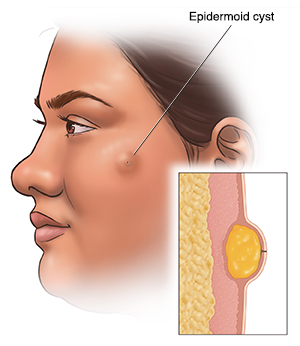
An epidermoid cyst, often incorrectly referred to as a sebaceous cyst, is a small noncancerous lump in the top layers of the skin. It's filled with keratin, the same proteins that make up your hair and nails. These cysts grow slowly. They can grow anywhere on the body. But they are most often found on the face, behind the ears, and on the chest, trunk, upper back, scrotum, and genitals.
How to say it
ehp-ih-DER-moid sihst
What causes an epidermoid cyst?
In most cases, epidermoid cysts occur for no known reason in any gender at any age, though they are more often seen in adults. Sometimes an epidermoid cyst may occur because of skin trauma, irritation of the skin or hair follicle, chronic sun damage, or genetics.
Symptoms of an epidermoid cyst
An epidermoid cyst is a bump under the skin. It may be yellow or skin-colored. It often has a small black mark in the middle of it, like a blackhead.
An epidermoid cyst rarely causes pain, unless it breaks open (ruptures) or becomes inflamed or infected. It may ooze keratin, a white, cheesy, smelly material. If the cyst becomes inflamed or infected, it may be:
-
Bad smelling.
-
Red.
-
Swollen.
-
Sore and tender to touch.
Treatment for an epidermoid cyst
Many epidermoid cysts don’t cause any problems. They don’t always need to be treated. They may go away on their own. Treatment may be needed if the cyst becomes inflamed or infected or is in an uncomfortable place. Treatment options include:
-
Steroid injection. A steroid may be injected into the cyst. This may help ease redness and pain caused by inflammation.
-
Antibiotics. In some cases, you may need to take an oral antibiotic to treat infection and reduce inflammation.
-
Surgical removal. The cyst can be cut out. Inflamed cysts are hard to remove. They may need to be drained or treated with antibiotics or steroids before surgery. In such cases, there is a slight chance the cyst may come back.
When to get medical care
Contact your health care provider or get medical care right away if you have:
-
A fever of 100.4°F (38°C) or higher, or as directed by your provider.
-
Redness, swelling, or fluid leaking from your incision that gets worse.
-
Pain that gets worse.
-
Symptoms that don’t get better or that get worse.
-
New symptoms.
Author: Semko, Laura
Online Medical Reviewer: Daphne Pierce-Smith RN MSN
Online Medical Reviewer: Rita Sather RN
Online Medical Reviewer: Vinita Wadhawan Researcher
Date Last Reviewed: 03/01/2025
© 2000-2026 The StayWell Company, LLC. All rights reserved. This information is not intended as a substitute for professional medical care. Always follow your healthcare professional's instructions.
Need Help? We're Here for You
Our Member and Recipient Services Team is here to help you understand your benefits, find care, or resolve concerns.
800-510-9132
Call NC Quitline
Need support to quit smoking, vaping, or to quit other nicotine products? You can receive support including medicines free of charge:
800-784-8669
Schedule Transportation
Need transportation to a doctor's office, pharmacy, or other covered healthcare service? Contact us to arrange your ride.
800-510-9132
Provider Directory
Need to find a provider like a Primary Care Physician, Specialist, OB/GYN, or a Psychiatrist?
Provider DirectoryRelated Articles
Seabather’s Eruption
Seabather's rash is an itchy, sore rash. It's caused by stings from tiny jellyfish. Here's what you need to know to care for yourself at home.
Nail Fungal Infection
A nail fungal infection changes the way fingernails and toenails look. They may thicken, discolor, change shape, or split. This condition is hard to treat because nails grow slowly and have limited blood supply. Here's how to care for this condition at home.
Understanding Contact Dermatitis
Contact dermatitis is a common type of skin rash. It's caused by something that touches the skin and makes it irritated and inflamed.
Scabies
Scabies is a skin infection caused by a tiny parasitic mite. Read on to learn how to care for scabies at home.


