If your movement is limited during recovery, ask a family member or friend to help prepare your bathroom. This helps make it safer and more comfortable while you heal. Use the tips below as a guide. Know that some equipment you’ll need won’t be ordered until you’re ready to go home.
Bathroom safety tips
Try the following tips for staying safe:
-
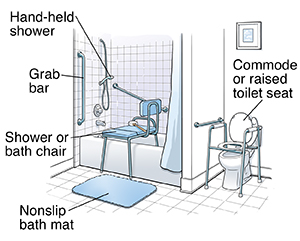
Prevent slips and falls by using nonslip bathmats on your bathroom floor and in your tub or shower.
-
Watch out for hazards, such as wet floors.
-
Use grab bars in your shower or tub for support as you get in and out. Also have them by your toilet.
-
Install a hand-held shower hose.
-
Keep the soap and shampoo within reach
-
Sit on a bath bench or shower chair while you bathe.
-
Use a long-handled sponge to wash hard-to-reach areas.
-
If you had surgery that limits bending, use a commode chair or elevated toilet seat to raise the height of your toilet.
-
Talk with your occupational therapist if you need more instructions in using bath aids.
Featured in
Online Medical Reviewer: Donna Freeborn PhD CNM FNP
Online Medical Reviewer: Jonas DeMuro MD
Online Medical Reviewer: Raymond Kent Turley BSN MSN RN
Date Last Reviewed: 01/15/2007
© 2000-2026 The StayWell Company, LLC. All rights reserved. This information is not intended as a substitute for professional medical care. Always follow your healthcare professional's instructions.
Need Help? We're Here for You
Our Member and Recipient Services Team is here to help you understand your benefits, find care, or resolve concerns.
800-510-9132
Call NC Quitline
Need support to quit smoking, vaping, or to quit other nicotine products? You can receive support including medicines free of charge:
800-784-8669
Schedule Transportation
Need transportation to a doctor's office, pharmacy, or other covered healthcare service? Contact us to arrange your ride.
800-510-9132
Provider Directory
Need to find a provider like a Primary Care Physician, Specialist, OB/GYN, or a Psychiatrist?
Provider DirectoryRelated Articles
Bladder and Bowel Care After Surgery
After any kind of surgery, many people have slow bowels and trouble urinating. This is common and lasts for a few days or so.
Wound Check After Surgery: Bleeding
It is normal to have some clear or bloody discharge on the wound covering or bandage for the first few days after surgery. Bleeding or discharge needing frequent dressing changes can be a sign of a problem. Read on for details.
Discharge from Outpatient Surgery
This sheet will help you learn what to expect after your outpatient surgery. It covers medicines, recovering at home, and follow-up care.
Wound Care After Surgery: Pain
It's normal to feel pain at the incision site. The pain decreases as the wound heals. Pain that continues more than a few weeks after surgery or pain that gets worse any time after surgery can be a sign of a problem.


