Deep coughing helps keep your lungs clear. If you’ve had surgery, this will help you get better faster. Deep coughing also helps you breathe easier and may prevent a lung infection or other complications. Follow these steps to do deep coughing.
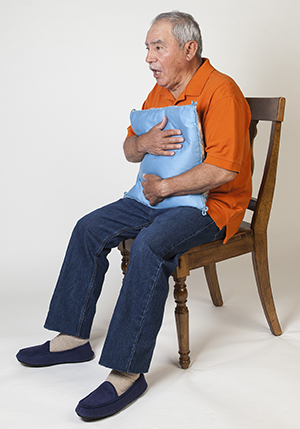
Step 1
-
Sit on the edge of a bed or a chair. You can also lie on your back with your knees slightly bent.
-
Lean forward slightly.
-
If you've had surgery on your chest or stomach, hold a pillow or rolled-up towel firmly against your cut (incision) with both hands. Hug the pillow.
-
Breathe out normally.
Step 2
-
Breathe in slowly and deeply through your nose.
-
Then breathe out fully through your mouth. Repeat this breathing in and out a second time.
-
For the third time, take a slow, deep breath through your nose. Fill your lungs with as much air as you can.
Step 3
-
Cough 2 or 3 times in a row. Try to push all of the air out of your lungs as you cough. Cover your cough, if possible, with a tissue or your elbow.
-
If you cough up mucus, spit it into a tissue. Don't swallow it.
-
Relax and breathe normally.
-
Repeat the above steps as directed.
-
Wash your hands with soap and clean, running water for 20 seconds afterward.
Follow-up care
Follow up with your health care provider as advised.
When to contact your doctor
Contact your health care provider right away if you have:
-
A fever of 100.4°F (38°C) or higher, or as advised by your provider.
-
Signs of infection, if you've had surgery. These include redness, swelling, drainage, or warmth at your incision site, or pus or fluid draining from the site.
-
Minor bleeding from the surgical site.
-
Brownish, yellowish, or bloody sputum (mucus).
-
Upset stomach (nausea) or vomiting.
-
More pain.
-
A fast or irregular heartbeat.
-
A new cough.
Call 911
Shortness of breath may be a sign of a serious health problem. Call
-
Confusion or trouble staying awake
-
Loss of consciousness or fainting
-
Chest pain or tightness
-
Trouble breathing or wheezing
-
Skin, lips, or fingernails turn blue
-
Coughing up blood
-
Severe pain
-
Dizziness or weakness
-
Severe bleeding or new opening at surgical site
Online Medical Reviewer: Chris Southard RN
Online Medical Reviewer: Daphne Pierce-Smith RN MSN
Online Medical Reviewer: Shaziya Allarakha MD
Date Last Reviewed: 03/01/2025
© 2000-2026 The StayWell Company, LLC. All rights reserved. This information is not intended as a substitute for professional medical care. Always follow your healthcare professional's instructions.
Need Help? We're Here for You
Our Member and Recipient Services Team is here to help you understand your benefits, find care, or resolve concerns.
800-510-9132
Call NC Quitline
Need support to quit smoking, vaping, or to quit other nicotine products? You can receive support including medicines free of charge:
800-784-8669
Schedule Transportation
Need transportation to a doctor's office, pharmacy, or other covered healthcare service? Contact us to arrange your ride.
800-510-9132
Provider Directory
Need to find a provider like a Primary Care Physician, Specialist, OB/GYN, or a Psychiatrist?
Provider DirectoryRelated Articles
Caring for a Closed Suction Drainage Tube
A drainage tube removes fluid from around an incision. This helps prevent infection and promotes healing. Follow these instructions.
Discharge Instructions: Caring for Your Hemovac Drainage Tube
A Hemovac drainage tube is used to remove fluid and is attached to a drain or collection device. This sheet can help you care for your Hemovac tube.
Wound Check After Surgery, No Complication
If your wound was sewn closed, you shouldn't have to change the dressing more than twice a day in the first few days. Follow these home care instructions after your wound check.
Wound Check After Surgery: Infection
Infection after surgery often affects just the top layers of skin. Sometimes the infection is deeper in the wound and may include a collection of fluid or pus. Treatment will depend on the type of infection.


