PCA (patient-controlled analgesia) allows you to push a button to get a dose of pain medicine. It is most commonly given through an IV (intravenous) line, a thin tube that goes into your vein. But you may also get pain medicine under the skin (subcutaneously) or into your spine (epidural space). PCA offers you a more constant level of pain relief than when medicine is given only when you ask for it.
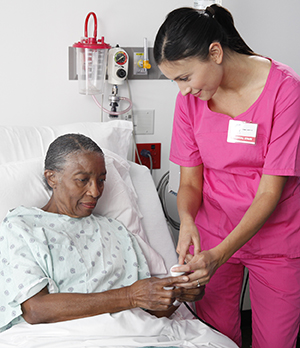
PCA pumps deliver opioids
-
Opioids are the most common medicines used to relieve pain after surgery.
-
Opioids affect pain centers at the spinal cord and in the brain. They are the medicine of choice to control even severe pain.
-
When used for a short time to control serious pain after surgery, or to treat other types of acute pain, opioids are not addictive.
-
Opioids may cause side effects such as constipation, nausea, vomiting, itching, rash, headaches, and, less commonly, breathing problems.
-
Let your health care provider know if you have any side effects.
PCA pumps have safety features
-
Your nurse programs the pump according to your health care provider’s instructions. You may just have the individual doses programmed. Or your provider may order continuous infusion along with the individual doses.
-
A safe dose of medicine is delivered each time you push the PCA button.
-
The pumps have a lockout time. During this time, you won’t get a dose of medicine even if you press the button.
-
You can get only a certain amount of medicine each hour. This is to reduce the chance for unwanted effects such as oversedation or breathing problems.
Safety monitoring during PCA use
-
Your nurse will need to monitor you often while you are using the PCA pump. The nurse may need to wake you up in order to assess for breathing problems and other side effects.
-
Family and friends staying with you during recovery should report any concerns of breathing problems or other side effects to the health care provider right away.
Important!
No one but the patient should push the PCA button. This includes your family or friends. If anyone but you pushes the button, you may get medicine when you don’t need it. This can cause life-threatening complications. It can also keep the pain medicine from working when you do need it.
Online Medical Reviewer: Jonas DeMuro MD
Online Medical Reviewer: L Renee Watson MSN RN
Online Medical Reviewer: Raymond Turley Jr PA-C
Date Last Reviewed: 02/01/2025
© 2000-2026 The StayWell Company, LLC. All rights reserved. This information is not intended as a substitute for professional medical care. Always follow your healthcare professional's instructions.
Need Help? We're Here for You
Our Member and Recipient Services Team is here to help you understand your benefits, find care, or resolve concerns.
800-510-9132
Call NC Quitline
Need support to quit smoking, vaping, or to quit other nicotine products? You can receive support including medicines free of charge:
800-784-8669
Schedule Transportation
Need transportation to a doctor's office, pharmacy, or other covered healthcare service? Contact us to arrange your ride.
800-510-9132
Provider Directory
Need to find a provider like a Primary Care Physician, Specialist, OB/GYN, or a Psychiatrist?
Provider DirectoryRelated Articles
Caring for a Closed Suction Drainage Tube
A drainage tube removes fluid from around an incision. This helps prevent infection and promotes healing. Follow these instructions.
Discharge Instructions: Caring for Your Hemovac Drainage Tube
A Hemovac drainage tube is used to remove fluid and is attached to a drain or collection device. This sheet can help you care for your Hemovac tube.
Wound Check After Surgery, No Complication
If your wound was sewn closed, you shouldn't have to change the dressing more than twice a day in the first few days. Follow these home care instructions after your wound check.
Discharge Instructions for Open Hernia Repair
You had a procedure called open hernia repair. A hernia is a tear or weakness in the wall of the belly. It causes internal organs to protrude through the wall of muscle or tissue that normally holds it in place. Surgery can help fix the weakness and stop symptoms.


