Surgery for erectile dysfunction (ED) isn't common, but it may be the best treatment in some cases. During surgery, your doctor places an implant (also called a prosthesis) inside the spongy chambers of your penis. Then, the implant can be used to provide an erection.
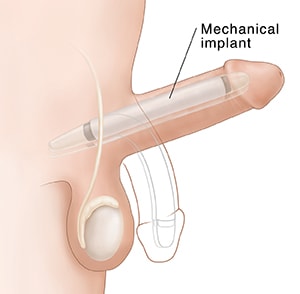
Mechanical implants
This type of implant is easy to use. Bendable rods can make your penis look erect. When not in use, the rods can be bent downward. Some implants have joints that lock the implant into position.
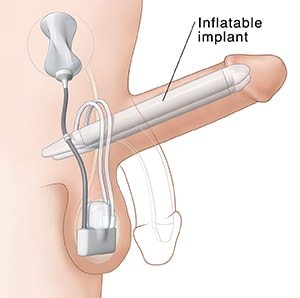
Inflatable implants
This is the most complex type of implant. It allows your penis to look and feel either erect or flaccid. You pump fluid from a storage bulb to make your penis erect. A release valve makes your penis flaccid again. Using the device correctly takes some skill and practice.
Risks and possible complications
All surgery has some risk. Possible complications from surgery for ED include:
- Infection
- Bleeding
- Failure or leakage of the prosthesis
- Wearing down of the prosthesis
When to contact your doctor
Contact your doctor right away if you have any of these:
- Fever of
100.4°F (38°C) or higher, or as advised by your doctor - Chills
- Trouble urinating
- Burning feeling when you urinate
- Continued or increasing pain, or pain that isn't eased by medicine
- Redness, swelling, or fluid leaking at your surgery site
- Shortness of breath
- Chest pain
- Upset stomach (nausea) and vomiting
Featured in
Online Medical Reviewer: Marc Greenstein MD
Online Medical Reviewer: Marianne Fraser MSN RN
Online Medical Reviewer: Raymond Kent Turley BSN MSN RN
Date Last Reviewed: 03/01/2024
© 2000-2026 The StayWell Company, LLC. All rights reserved. This information is not intended as a substitute for professional medical care. Always follow your healthcare professional's instructions.
Need Help? We're Here for You
Our Member Services team is here to help you understand your benefits, find care, or resolve concerns.
1-800-510-9132
Call NC Quitline
Need support to quit smoking, vaping, or to quit other nicotine products? You can receive support including medicines free of charge:
1-800-784-8669
Schedule Transportation
Need transportation to a doctor's office, pharmacy, or other covered healthcare service? Contact us to arrange your ride.
1-800-510-9132
Provider Directory
Need to find a provider like a Primary Care Physician, Specialist, OB/GYN, or a Psychiatrist?
Provider DirectoryRelated Articles
Pre-Surgery Checklist
You are scheduled to have surgery. The health care staff will try to make your stay comfortable. Use the guidelines below to remind yourself what to do before surgery.
Having Thyroid Surgery
You're having surgery to remove part or all of your thyroid. Learn what to expect before, during, and after the procedure.
Preparing for Outpatient Surgery
Outpatient surgery is also called same-day or ambulatory surgery. This sheet gives you more information about how to prepare.
Getting Healthy Before Surgery
Being as physically healthy as possible before surgery is important. It can help shorten your hospital stay and your total healing time.


