The bladder is part of your urinary tract. It's a hollow organ in your lower belly (pelvis). Urine is stored in it. This is the liquid waste that's made by the kidneys. Urine flows away from each kidney through a tube called a ureter. The ureters carry the urine into your bladder. The urine stays in your bladder until you let it pass out of your body through another tube called the urethra. You use ring-shaped muscles called sphincter muscles to control urine flow.
An outer layer of smooth muscle called the detrusor muscle surrounds the bladder. When your bladder is full, the muscles in the bladder wall can be tightened to squeeze out the urine. As you urinate, the bladder shrinks in size.
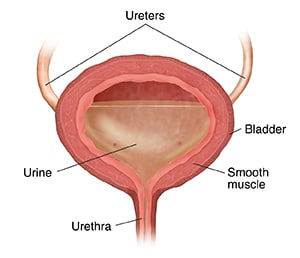
The bladder wall is made of many layers, including:
- Urothelium or transitional epithelium. This is the layer of cells that lines the inside of the kidneys, ureters, bladder, and urethra. Cells in this layer are called urothelial cells or transitional cells.
- Lamina propria. This is the next layer around the urothelium. It's a type of connective tissue.
- Detrusor muscle (muscularis propria). This is the outer layer. It's the thick smooth muscle tissue outside the lamina propria.
- Fatty connective tissue. This covers the outside of the bladder and separates it from other organs.
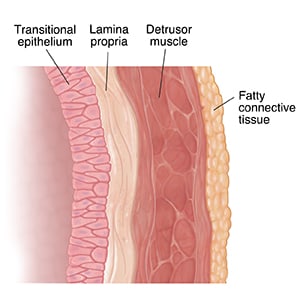
Superficial bladder cancer affects only the inside lining of the bladder. This is the transitional epithelium. Cancer here is called transitional cell carcinoma or urothelial carcinoma. As the cancer grows, it can become invasive bladder cancer that goes into deeper layers of the bladder wall. Over time, it can grow into the fatty connective tissue.
Date Last Reviewed: 05/01/2023
© 2026 The StayWell Company, LLC. All rights reserved. This information is not intended as a substitute for professional medical care. Always follow your healthcare provider's instructions.
Need Help? We're Here for You
Our Member and Recipient Services Team is here to help you understand your benefits, find care, or resolve concerns.
800-510-9132
Call NC Quitline
Need support to quit smoking, vaping, or to quit other nicotine products? You can receive support including medicines free of charge:
800-784-8669
Schedule Transportation
Need transportation to a doctor's office, pharmacy, or other covered healthcare service? Contact us to arrange your ride.
800-510-9132
Provider Directory
Need to find a provider like a Primary Care Physician, Specialist, OB/GYN, or a Psychiatrist?
Provider DirectoryRelated Articles
Understanding Types of Health Care Facilities
Getting quality health care doesn’t always mean going into the hospital or emergency room. Depending on your needs, other medical facilities may serve you just as well—or even better.
Ileostomy: Nutritional Management
You don't have to eat a special diet just because you've had an ileostomy. Most foods, chewed well and eaten slowly, won't give you problems, unless they did before. But you may need to be more aware of foods that make your stool more watery than normal and foods that cause gas or odor. You also need plenty of fluids and vitamins.
Staff Ed: Making Sure Your Patients Get Vaccines
The most important thing ensuring that patients get vaccines may be as simple as your direct and clear recommendation to them.
Influenza (Flu) Vaccine (Inactivated or Recombinant): VIS
Influenza vaccine can prevent influenza (flu). Flu is a contagious disease that spreads around the United States every year, usually between October and May.


