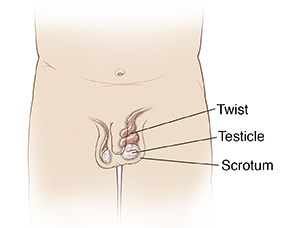
Your child’s testicle was twisted inside their scrotum. This is called testicular torsion. When the testicle twists in this way, the spermatic cord is twisted. Then the blood vessels in the spermatic cord are squeezed (compressed). This reduces blood flow to the testicle. Testicular torsion is a medical emergency.
It's very painful on the side of the affected testicle. It may also cause fever or vomiting. If not treated right away, the testicle can die and will have to be removed. The condition can also lead to problems having children (infertility). If treatment occurs within 6 hours, about 100% of the time the testicle can be saved. After 24 hours, this drops to nearly 0%.
Your child's testicle was untwisted by hand. This is called manual detorsion. This method is used when surgery isn't available within 2 hours. A series of ultrasounds can also be used to check for the return of blood flow to the testicle. If it was not successful, manual detorsion may be done again because the testicle can twist 180 degrees. Your child will still need surgery to stop the problem from coming back. Your child will also need surgery on the other testicle to fix the problem that causes the condition.
Testicular torsion can occur from injury or strenuous physical activity. Or it can occur suddenly.
Follow-up care
Bring your child to a urologist as soon as you can. Ideally, this should be in less than a week. The sooner the surgery is done, the less risk there is of the problem coming back. And there is less risk of possible loss of the testicle or of infertility. If symptoms come back, get your child medical care right away.
When to get medical advice
Contact your child's doctor right away if your child has:
-
Pain or swelling in the testicle or scrotum. If symptoms come back, it's a medical emergency.
-
A fever of 100.4ºF (38°C) or above, or as advised by your child's doctor.
-
Chills.
-
Nausea or vomiting that won't go away.
-
Pain in the belly (abdomen).
-
Trouble peeing.
-
Shrinking of the testicle.
Featured in
Online Medical Reviewer: Dan Brennan MD
Online Medical Reviewer: Lalitha Kadali
Online Medical Reviewer: Raymond Kent Turley BSN MSN RN
Date Last Reviewed: 04/01/2025
© 2000-2026 The StayWell Company, LLC. All rights reserved. This information is not intended as a substitute for professional medical care. Always follow your healthcare professional's instructions.
Need Help? We're Here for You
Our Member Services team is here to help you understand your benefits, find care, or resolve concerns.
1-800-510-9132
Call NC Quitline
Need support to quit smoking, vaping, or to quit other nicotine products? You can receive support including medicines free of charge:
1-800-784-8669
Schedule Transportation
Need transportation to a doctor's office, pharmacy, or other covered healthcare service? Contact us to arrange your ride.
1-800-510-9132
Provider Directory
Need to find a provider like a Primary Care Physician, Specialist, OB/GYN, or a Psychiatrist?
Provider DirectoryRelated Articles
When Your Child Needs Bladder Reconstruction Surgery
Your child is having surgery on their bladder. You may feel scared for your child and have many questions. This is normal. Learn what to expect with the surgery and discuss any questions or concerns you may have with your child's healthcare provider.
Discharge Instructions: Caring for Your Indwelling Urinary Catheter
You have been discharged with an indwelling urinary catheter (also called a Foley catheter). A catheter is a thin, flexible tube. An indwelling urinary catheter has two parts. These instructions will help you care for your catheter and prevent infection.
When Your Child Needs Laparoscopic Urologic Surgery
Your doctor has recommended laparoscopic urologic surgery for your child. This is to help diagnose or treat a problem in the urinary tract. Learn more about this type of surgery, and what to expect before, during, and after this procedure.
When Your Child Has Hematuria: Urologic Causes
It can be scary to hear that your child has blood in their urine. But there are many reasons why hematuria occurs that are not serious.


