You and your doctor can talk about other ways to manage your incontinence. These may be used with other treatments, or used alone. Your doctor may teach you ways to train your bladder. Keeping a bladder diary can help.
Other helpful changes include cutting back on drinks that increase the urge to urinate, such as those with alcohol or caffeine. Limiting drinks at night may also help. Other lifestyle changes that may help prevent incontinence include getting to or keeping an ideal weight, being physically active, quitting smoking, and avoiding constipation.
Timed voiding
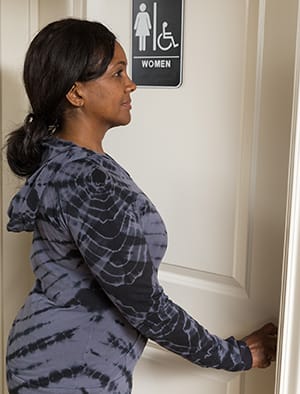
Timed voiding means urinating on a set schedule. This empties the bladder and helps prevent accidents. Visit the bathroom at the scheduled time. Don't wait until you have the urge to urinate. Your doctor can suggest how often you should urinate.
Bladder retraining
If you have urge incontinence, you may be used to going to the bathroom very often. To help retrain your bladder, your doctor may suggest using Kegel exercises. Each time you feel the urge to go, try to stop the feeling by contracting your pelvic floor muscles. To learn which muscles to contract, you can try to stop the stream of urine by contracting the pelvic floor muscles. These exercises help strengthen and control your bladder muscles. But Kegel exercises should be done when you don't have to urinate. It's not advised to do them each time you urinate. Your doctor can give you a goal to work up to. This treatment should never be used in children.
Self-catheterization
Catheterization uses a thin tube (catheter) to drain urine from the bladder. The catheter is put into the bladder through the urethra. You may be asked to do self-catheterization. Regularly draining your bladder of urine can help control overflow incontinence. It doesn't hurt and is easy to learn. If this treatment will help you, your doctor will teach you how to do it.
Online Medical Reviewer: Marc Greenstein MD
Online Medical Reviewer: Raymond Kent Turley BSN MSN RN
Online Medical Reviewer: Rita Sather RN
Date Last Reviewed: 09/01/2025
© 2000-2026 The StayWell Company, LLC. All rights reserved. This information is not intended as a substitute for professional medical care. Always follow your healthcare professional's instructions.
Need Help? We're Here for You
Our Member Services team is here to help you understand your benefits, find care, or resolve concerns.
1-800-510-9132
Call NC Quitline
Need support to quit smoking, vaping, or to quit other nicotine products? You can receive support including medicines free of charge:
1-800-784-8669
Schedule Transportation
Need transportation to a doctor's office, pharmacy, or other covered healthcare service? Contact us to arrange your ride.
1-800-510-9132
Provider Directory
Need to find a provider like a Primary Care Physician, Specialist, OB/GYN, or a Psychiatrist?
Provider DirectoryRelated Articles
Urethral Cancer: Chemotherapy
Chemotherapy (chemo) uses medicines to kill cancer cells. Learn how it works for urethral cancer.
Bladder Cancer: Chemotherapy
Chemotherapy (chemo) uses anticancer medicines to kill cancer cells. Learn how this type of treatment is used for bladder cancer.
Understanding Strength Training
Strength training is an activity that builds up your muscles. It can be done with weights, resistance bands, or your own body weight.
Understanding Hydrodistention With Cystoscopy
Hydrodistention is a procedure that fills up your bladder with water. It is used to help find out what may be causing your bladder pain. Learn more about the procedure, including why and how it's done and what the risks are.


