A vasectomy is a minor surgical procedure that prevents a man from getting a woman pregnant. It's the permanent birth control method that works best for men.
Your reproductive system
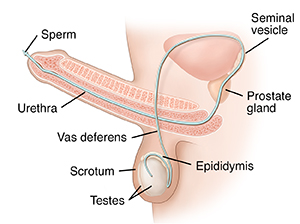
For pregnancy to occur, a man’s sperm (male reproductive cells) must join with a woman’s egg. To understand how a vasectomy works, you need to know how sperm are made, stored, and released by the body:
-
The urethra is the tube in the center of the penis. It transports both urine and semen. When you have an orgasm, semen is ejaculated out of the urethra.
-
The seminal vesicles and the prostate gland secrete fluids called semen. This sticky, white fluid helps nourish sperm and carry them along.
-
The epididymis is a coiled tube that holds the sperm while they mature.
-
The scrotum is a pouch of skin that contains the testes.
-
The testes are glands that make sperm and male hormones.
-
The vas deferens are tubes that carry the sperm from the epididymis to the penis.
-
Sperm (shown as a blue arrow) carry genetic material.
How a vasectomy works
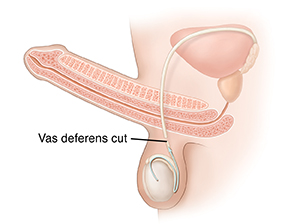
During the procedure, the two vas deferens are cut and sealed off. This prevents sperm from traveling from the testes to the penis. It is the only change in your reproductive system. The testes still produce sperm. But since the sperm have nowhere to go, they die and are absorbed by your body. Only a very small amount of semen is made up of sperm. So after a vasectomy, your semen won’t look or feel any different.
A permanent decision
A vasectomy is a permanent form of birth control. Before having this procedure, you must be sure that you don't want to have children in the future. In some cases, it's possible to have a procedure to undo (reverse) the vasectomy; however, not all vasectomies can be reversed. The most effective way to reverse a vasectomy is by microsurgery that is done in a hospital or outpatient surgery center. This procedure is often not covered by insurance.
Keep in mind
After a vasectomy, some active sperm still remain in the reproductive system. It will take at least 3 months or longer and many ejaculations before the semen is completely free of sperm. You shouldn't assume your vasectomy is effective until a semen analysis proves it is. Until then, you’ll need to use another form of birth control.
Featured in
Online Medical Reviewer: Marianne Fraser MSN RN
Online Medical Reviewer: Raymond Kent Turley BSN MSN RN
Online Medical Reviewer: Rita Sather RN
Date Last Reviewed: 03/01/2024
© 2000-2026 The StayWell Company, LLC. All rights reserved. This information is not intended as a substitute for professional medical care. Always follow your healthcare professional's instructions.
Need Help? We're Here for You
Our Member and Recipient Services Team is here to help you understand your benefits, find care, or resolve concerns.
800-510-9132
Call NC Quitline
Need support to quit smoking, vaping, or to quit other nicotine products? You can receive support including medicines free of charge:
800-784-8669
Schedule Transportation
Need transportation to a doctor's office, pharmacy, or other covered healthcare service? Contact us to arrange your ride.
800-510-9132
Provider Directory
Need to find a provider like a Primary Care Physician, Specialist, OB/GYN, or a Psychiatrist?
Provider DirectoryRelated Articles
Laparoscopic Varicocelectomy
Varicocelectomy is surgery to fix a varicocele. A varicocele is swelling of veins in the scrotum. This swelling is due to blood backing up in the veins.
Treating Varicocele
A varicocele is when the veins in your scrotum are enlarged. Your doctor may advise surgery or another procedure to close off the enlarged veins. Read on for more details about these treatments.
Balanitis
Balanitis is an inflammation of the head of the penis. It can happen because of a buildup of germs (bacteria, viruses, or fungi) under the foreskin, or exposure to soaps and other chemicals. Learn how to care for yourself at home.
Robotic Prostatectomy
Prostatectomy is surgery to remove the prostate gland. Learn about robotic prostatectomy, a minimally invasive procedure, including what you can expect before, during, and after surgery.


