An abscess is a pocket of infection that has liquid called pus. An infection like this in the kidney is called a renal abscess.
What causes a renal abscess?
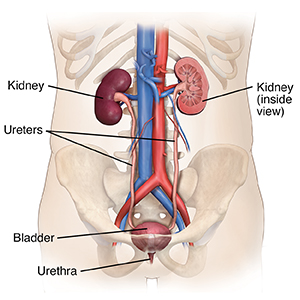
You have 2 kidneys. They filter your blood and make urine. You have 2 tubes called ureters that carry urine from the kidneys to the bladder. A tube called the urethra carries urine out of the body from the bladder. This system is called the urinary tract. If bacteria travel up these tubes, they can reach the kidneys and cause an infection or abscess.
Sometimes infection from other parts of the body can spread through blood to the kidney and cause renal abscess.
You’re at risk for a renal abscess if you have any of these:
-
Urinary tract infection (UTI)
-
Kidney stones
-
Urine that flows up the ureters to the kidneys (vesicoureteral reflux)
-
Diabetes
-
Recent surgery, injury, or a growth in the urinary tract
-
Skin abscess
-
Intravenous drug abuse
Symptoms of a renal abscess
Symptoms can include:
-
Fever
-
Chills
-
Fatigue
-
Pain in your belly, lower back, or side
-
Loss of appetite
-
Weight loss
Diagnosing a renal abscess
Your health care provider will ask about your symptoms and health history. You may have tests, such as:
-
X-ray. This test uses a small amount of radiation to create pictures of your organs.
-
Ultrasound. This test uses sound waves to create images of your organs on a computer screen.
-
CT scan. This test uses a series of X-rays and a computer. You may also be given a chemical in your bloodstream to help make clearer images.
-
Blood tests. These tests can show how well the kidneys are working. They can also show signs of infection.
Treatment for a renal abscess
Types of treatment include:
-
Antibiotic medicine. You will be given antibiotics to kill the bacteria causing your infection. Take them as directed. Do not stop taking them just because you feel better. You need to take the full course of antibiotics.
-
Draining the fluid. You may also have the fluid drained from the abscess. This is done through the skin with a needle. Ultrasound is used to make sure the needle goes to the right spot. You may have a thin tube (catheter) in place for 1 or more days. This is to keep draining the fluid.
-
Surgery. If your abscess was caused by an injury or growth, you may need surgery to fix the problem. You may need surgery if the abscess is very large or the kidney is very damaged.
Possible complications of a renal abscess
A renal abscess can cause kidney damage. In severe cases, the kidney may need to be removed. In a person with diabetes, a severe abscess can be hard to treat. It may lead to serious illness and death.
When to contact your doctor
Contact your provider if:
-
You have a fever of
100.4 °F (38 °C) or higher.
-
Your pain gets worse.
-
Your symptoms don’t get better, or get worse.
-
You have new symptoms.
Date Last Reviewed: 04/01/2025
© 2000-2026 The StayWell Company, LLC. All rights reserved. This information is not intended as a substitute for professional medical care. Always follow your healthcare professional's instructions.
Need Help? We're Here for You
Our Member Services team is here to help you understand your benefits, find care, or resolve concerns.
1-800-510-9132
Call NC Quitline
Need support to quit smoking, vaping, or to quit other nicotine products? You can receive support including medicines free of charge:
1-800-784-8669
Schedule Transportation
Need transportation to a doctor's office, pharmacy, or other covered healthcare service? Contact us to arrange your ride.
1-800-510-9132
Provider Directory
Need to find a provider like a Primary Care Physician, Specialist, OB/GYN, or a Psychiatrist?
Provider DirectoryRelated Articles
Understanding Kidney Stones
Read on to learn about kidney stones, including why and where they form, and symptoms.
Hemodialysis Access Bleeding
You have a hemodialysis access in your arm, either an arteriovenous (AV) fistula or an artery to vein graft. It has been bleeding. Blood needs to flow freely through the fistula or graft. As part of your treatment, you are also taking medication that thins your blood. This makes you bleed more easily. It is important to stop your fistula or graft from bleeding as soon as possible.
Simple Kidney Cysts
Simple kidney cysts are fluid-filled sacs that form in your kidneys. These cysts often don't affect how the kidneys function. Simple kidney cysts are very common. They rarely need treatment. Most people don't even know that they have them. Read on to learn more.
Exercising Safely
If you feel safe and comfortable while exercising, you are more likely to stick with your exercise program.


