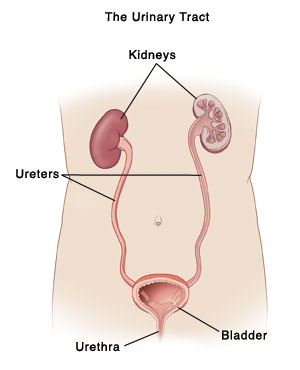
Voiding cystourethrogram (VCUG) is a test that uses X-rays to show the flow of urine through the urinary tract. VCUG uses a special form of X-ray called fluoroscopy and a contrast material. It allows the doctor to see how your child’s bladder functions. It also shows if urine is flowing backward into the kidneys or if another urinary problem is present.
Before the test
-
Explain what is happening in an age-appropriate manner. Tell your child who the people are that they'll be seeing and why the test is being done.
-
Help your child change into a hospital gown.
-
Remove your child’s jewelry and glasses, if they are worn.
-
Tell your child’s doctor and the technician giving the test if your child is allergic to medicine or the contrast used for the test.
-
Tell the doctor about any conditions or illnesses your child has had recently. If the child is having a urinary tract infection (UTI), they should have completed a course of antibiotics and should not have a fever on the day of the exam.
-
Tell the doctor about any medicines your child is taking.
During the test
-
The test lasts about 30 minutes. You may be allowed to be with your child during the test.
-
For the test, your child lies on their back on an X-ray table. If your child is an infant or toddler, they may be wrapped in a blanket or another restraint to keep them still during the test.
-
Several X-rays are taken. The X-rays may be seen on a video screen.
-
The genital area is cleaned with an antiseptic.
-
A thin, flexible tube called a catheter is then gently put into the urethra. The urethra is the tube that carries urine out of the body. This may cause some mild pain for a moment. The catheter is then slowly passed into the bladder.
-
A special dye called contrast is put into the catheter to fill the bladder. The contrast makes the bladder show up clearly on the X-ray.
-
More X-rays are taken while the bladder is filled with contrast.
-
The catheter is removed and your child is asked to urinate. More X-rays are taken as the bladder empties.
After the test
-
Your child can get back to normal activities after the test.
-
If your child was given contrast, it will pass naturally within a day.
-
Have your child drink lots of water to help the dye pass out of the body.
-
Sometimes children will complain of having trouble or pain with urination after the test. Or you may see a small amount of blood in the urine. This is due to irritation from the tube that was placed in your child's urethra. If the symptoms are getting worse or are concerning you at home, contact your child's doctor.
Getting your child’s results
Your child’s doctor will discuss the test results with you during a follow-up appointment or over the phone. You can talk about treatment choices at this time if needed.
Online Medical Reviewer: Marc Greenstein MD
Online Medical Reviewer: Marianne Fraser MSN RN
Online Medical Reviewer: Raymond Kent Turley BSN MSN RN
Date Last Reviewed: 04/01/2025
© 2000-2026 The StayWell Company, LLC. All rights reserved. This information is not intended as a substitute for professional medical care. Always follow your healthcare professional's instructions.
Need Help? We're Here for You
Our Member Services team is here to help you understand your benefits, find care, or resolve concerns.
1-800-510-9132
Call NC Quitline
Need support to quit smoking, vaping, or to quit other nicotine products? You can receive support including medicines free of charge:
1-800-784-8669
Schedule Transportation
Need transportation to a doctor's office, pharmacy, or other covered healthcare service? Contact us to arrange your ride.
1-800-510-9132
Provider Directory
Need to find a provider like a Primary Care Physician, Specialist, OB/GYN, or a Psychiatrist?
Provider DirectoryRelated Articles
Differences of Sex Development (DSD)
When a child's gender is in question at birth, the child has atypical genitalia (ambiguous genitalia). This means that the genitals don't seem to be clearly male or female.
Dysuria: Infection vs. Chemical (Child)
Dysuria is having pain or a burning feeling in the urethra when you pee. Learn how to care for your child with dysuria.
When Your Child Needs Bladder Reconstruction Surgery
Your child is having surgery on their bladder. You may feel scared for your child and have many questions. This is normal. Learn what to expect with the surgery and discuss any questions or concerns you may have with your child's healthcare provider.
Discharge Instructions: Caring for Your Indwelling Urinary Catheter
You have been discharged with an indwelling urinary catheter (also called a Foley catheter). A catheter is a thin, flexible tube. An indwelling urinary catheter has two parts. These instructions will help you care for your catheter and prevent infection.


