An X-ray uses a small amount of radiation to make images of your bones and organs. X-rays are most often used to look for bone or joint problems, or to check the heart and lungs (chest X-ray). They are also used to look for any hard deposits of minerals or salts in your body, such as kidney stones. You may also have an X-ray to check for problems in the bowel, such as a blockage or free air in the belly (abdomen). X-rays are also used to look for a foreign object in your body, such as metal. This can be from an injury or a swallowed object.
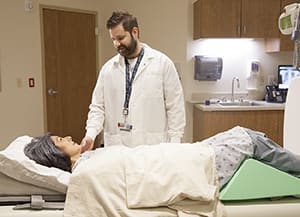
Tell the X-ray technologist
Tell them if you:
- Are or may be pregnant.
- Had an X-ray of this part of your body before.
- Have any metal objects on your body or clothes.
Before your test
Before the test starts, you may be asked:
- To remove your watch, jewelry, or clothes with metal closures from the part of your body being X-rayed. These items can block part of the image.
- To put on a hospital gown.
- About your overall health and any medicines you take.
During your test
Here is what to expect during the test:
- You may be asked to sit, stand, or lie on a table.
- A lead apron may be draped to protect the areas of your body not being X-rayed.
- With an X-ray of your chest or belly, you may have to take a deep breath and hold it for a few seconds.
- Each exam usually needs at least 2 X-ray views. You may need to move your body before each new X-ray view.
After your test
Your doctor will discuss the test results with you during a follow-up appointment or over the phone.
They may advise other imaging tests (such as an MRI or a CT scan) or more X-ray views if needed. This is done to confirm the diagnosis.
Online Medical Reviewer: Marianne Fraser MSN RN
Online Medical Reviewer: Raymond Turley Jr PA-C
Online Medical Reviewer: Shaziya Allarakha MD
Date Last Reviewed: 03/01/2024
© 2000-2026 The StayWell Company, LLC. All rights reserved. This information is not intended as a substitute for professional medical care. Always follow your healthcare professional's instructions.
Need Help? We're Here for You
Our Member and Recipient Services Team is here to help you understand your benefits, find care, or resolve concerns.
800-510-9132
Call NC Quitline
Need support to quit smoking, vaping, or to quit other nicotine products? You can receive support including medicines free of charge:
800-784-8669
Schedule Transportation
Need transportation to a doctor's office, pharmacy, or other covered healthcare service? Contact us to arrange your ride.
800-510-9132
Provider Directory
Need to find a provider like a Primary Care Physician, Specialist, OB/GYN, or a Psychiatrist?
Provider DirectoryRelated Articles
Computed Tomography (CT) Scan
A computed tomography (CT) scan is an imaging test that takes detailed pictures of your soft tissues. Learn what to expect before, during, and after the test.
Computed Tomography Angiography (CTA)
CTA is an imaging test that makes detailed pictures of your blood vessels.
Radiation Therapy Team
Radiation therapy uses high-energy X-rays or particles to kill cancer cells. This therapy can help you in your fight against cancer. Your radiation therapy team will work with you during your treatment.
Myelogram
A myelogram is a test to check problems with your spinal canal. It often uses a real-time form of X-ray (fluoroscopy).