A pain scale helps you rate pain intensity. In the scale, 0 means no pain, and 10 is the worst pain possible. Pain scales aren't used to compare your pain with another person's pain. A pain scale is used only to measure how your pain changes for you. You should rate your pain every few hours. You may feel some pain even with medicines. It's important to tell your health care provider if medicines don't reduce the pain. Be sure to mention if the pain suddenly increases or changes.

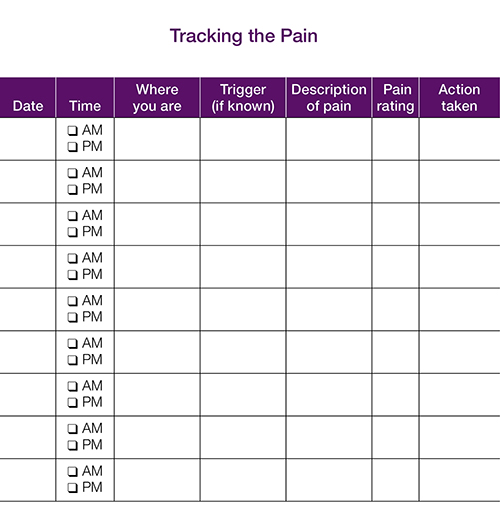
Keep track of your pain each day. You might copy the pain journal on this page or use a small notebook. Show the journal to your health care provider.
Online Medical Reviewer: Jimmy Moe MD
Online Medical Reviewer: Raymond Kent Turley BSN MSN RN
Online Medical Reviewer: Tennille Dozier RN BSN RDMS
Date Last Reviewed: 01/01/2025
© 2000-2026 The StayWell Company, LLC. All rights reserved. This information is not intended as a substitute for professional medical care. Always follow your healthcare professional's instructions.
Need Help? We're Here for You
Our Member Services team is here to help you understand your benefits, find care, or resolve concerns.
1-800-510-9132
Call NC Quitline
Need support to quit smoking, vaping, or to quit other nicotine products? You can receive support including medicines free of charge:
1-800-784-8669
Schedule Transportation
Need transportation to a doctor's office, pharmacy, or other covered healthcare service? Contact us to arrange your ride.
1-800-510-9132
Provider Directory
Need to find a provider like a Primary Care Physician, Specialist, OB/GYN, or a Psychiatrist?
Provider DirectoryRelated Articles
Understanding the Risks and Side Effects of Opioid Medicines
When opioids are taken as prescribed, they can help manage pain effectively. But these medicines come with risks and side effects that are important to understand.
Managing Chronic Pain: Therapies for Mind and Body
Both the brain and the body are involved in the pain response. The brain "reads" the pain signals from the body. This means that your mind has some control over how pain signals are processed. Mind-body therapies may help change how your brain "reads" pain signals.
Continuous Epidural Infusion for Pain Relief
Continuous epidural infusion is a way to give pain medicine. The medicine is sent to the spinal cord and nerves. This is done through a soft tube (catheter). The catheter is put in the spine into the epidural space, which surrounds the spinal cord.
Home Infusion Therapy: Preventing Infection
Infusion therapy is a safe way to take medicines or fluids that can’t be taken by mouth. Here's how to prevent infection when doing infusion therapy at home.