Most kids outgrow bedwetting over time. But your child's healthcare provider may suggest ways to speed up the process. This includes the following ideas.
The self-awakening routine
To overcome bedwetting, your child must learn to wake up when it’s time to urinate. These tips will help:
-
If your child wakes up for any reason, they should get out of bed and try to use the toilet.
-
If your child wakes and the bed is wet, they should help change the sheets and wet pajamas before going back to bed.
-
Every night, have your child lie on the bed. Have your child pretend to sleep and imagine they have to urinate. Your child should get up, walk to the bathroom, and try to urinate. This helps teach the habit of getting out of bed to use the toilet.
-
Try waking your child up to take them to the bathroom a few hours after they go to sleep. Some research shows that this can help children stay dry at night.
Bedwetting alarms
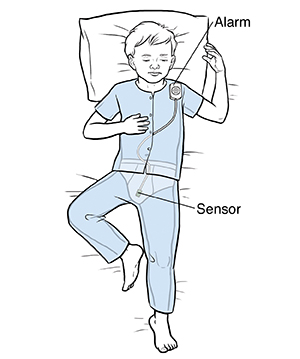
A specially designed alarm may help teach a child to wake up to urinate. These are available at pharmacies, medical supply stores, and online. Here’s how they work:
-
The alarm has a sensor. It attaches either to the underwear or to a pad on the bed. A noisy alarm may be worn around the wrist or on the shoulder near the ear. Or, a vibrating alarm may be placed under the child’s pillow.
-
If the child starts to urinate, the alarm goes off. This wakes the child up. They can then get up and use the toilet.
-
Some children sleep through the alarm at first. You may need to wake your child when you hear the alarm.
Other lifestyle changes
-
Have your child drink more during the day and drink less in the evening. This may help keep the bladder empty during the night. But don’t limit drinks altogether. This can cause fluid loss (dehydration).
-
Limit drinks with caffeine (such as colas and other sodas) at dinner. Caffeine stimulates urination. Also limit chocolate, which has caffeine.
-
Encourage your child to use the bathroom regularly during the day.
Medicines
Medicines may be an option for a child who:
-
Is at least 7 years old
-
Still wets the bed after other methods have been tried
Medicines come in nasal spray, pill, or liquid form. They may reduce the amount of urine the body makes overnight. They may also help the bladder hold more fluid. Medicines can give your child extra help staying dry during vacations. Or on overnight stays away from home. But keep in mind that medicines don’t usually cure bedwetting. And they’re not a long-term solution. They can also have side effects. Talk with the healthcare provider about using them safely.
Featured in
Online Medical Reviewer: Lalitha Kadali
Online Medical Reviewer: Melinda Murray Ratini DO
Online Medical Reviewer: Rita Sather RN
Date Last Reviewed: 12/01/2024
© 2000-2026 The StayWell Company, LLC. All rights reserved. This information is not intended as a substitute for professional medical care. Always follow your healthcare professional's instructions.
Need Help? We're Here for You
Our Member and Recipient Services Team is here to help you understand your benefits, find care, or resolve concerns.
800-510-9132
Call NC Quitline
Need support to quit smoking, vaping, or to quit other nicotine products? You can receive support including medicines free of charge:
800-784-8669
Schedule Transportation
Need transportation to a doctor's office, pharmacy, or other covered healthcare service? Contact us to arrange your ride.
800-510-9132
Provider Directory
Need to find a provider like a Primary Care Physician, Specialist, OB/GYN, or a Psychiatrist?
Provider DirectoryRelated Articles
Childhood Vaccines
To be healthy, your child should receive the recommended childhood vaccines. Read on to learn more about the recommended vaccines and when they should be given.
Discharge Instructions: Taking an Axillary Temperature (Child)
Learn how to take your child's temperature under the arm. This is called the axillary temperature.
Child Vaccine Schedule
This list of childhood vaccines and when to give them is based on CDC recommendations.
Sleep and Your Child
Without enough shut-eye, children are more likely to struggle with their school studies, do poorly on the playing field, and suffer depression.