As you and your child go through these years together, expect some problems along the way. You’ll both make mistakes, but you can learn from them. Keep in mind that many problems that children in this age group have are just a phase. They’re just a normal part of growing up.
Testing the rules
Children in this age group tend to be more focused on friends and school. They may be social and talk a lot, even when they’re not supposed to. It may be annoying, but this type of behavior is often a brief phase. Children test the rules to find out just how far they can go. This is true whether a child’s parents go to work or not.
New worries
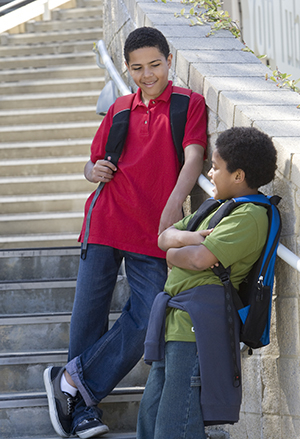
As they get older, children begin to get around by themselves. They may go to school and after-school programs without an adult. This can ease some of the pressure of child care for you. But it may mean new concerns. The new concerns can include dangerous strangers, traffic safety, or unfriendly dogs.
Safety out and about
Encourage your child to talk to you about their travels from place to place. Ask them to tell you about anything that has happened. Teach your child how to spot good strangers (such as police officers) and bad strangers. Tell them to stick with groups of friends, and to obey traffic rules.
Safety at home
If a supervised after-school program is not available, you may worry if your child is OK being home alone. Does your child feel scared or lonely? You will both feel safer if you have a set of rules and a schedule. A check-in call to you or another responsible adult each day can help too.
While each child is unique, experts generally agree that by age 11 or 12, a child may be able to stay home alone during the day for no more than 3 hours. This may be the case as long as:
-
The area is safe.
-
The child has an emergency contact.
-
The child can handle the responsibility.
Featured in
Online Medical Reviewer: Liora C Adler MD
Online Medical Reviewer: Louise Cunningham RN BSN
Online Medical Reviewer: Paula Goode RN BSN MSN
Date Last Reviewed: 05/01/2025
© 2000-2026 The StayWell Company, LLC. All rights reserved. This information is not intended as a substitute for professional medical care. Always follow your healthcare professional's instructions.
Need Help? We're Here for You
Our Member and Recipient Services Team is here to help you understand your benefits, find care, or resolve concerns.
800-510-9132
Call NC Quitline
Need support to quit smoking, vaping, or to quit other nicotine products? You can receive support including medicines free of charge:
800-784-8669
Schedule Transportation
Need transportation to a doctor's office, pharmacy, or other covered healthcare service? Contact us to arrange your ride.
800-510-9132
Provider Directory
Need to find a provider like a Primary Care Physician, Specialist, OB/GYN, or a Psychiatrist?
Provider DirectoryRelated Articles
Keep Kids Safe During Yard Work
Power tools make yard work easier, from mowing the lawn to trimming the bushes. But these tools also pose a threat to children if precautions aren't taken. Read on for important safety steps.
Stages of Play
Children go through distinct stages of play as they grow. Each stage is critically important to the development of the next.
For Parents: Helmet Safety Checklist
The right helmet and other safety equipment can protect the head when biking, in-line skating, roller-skating, or skateboarding. But they only protect if worn correctly. Here's a helmet safety checklist for parents to keep their kids safe.
Watch That Backpack Load
Most children rely on backpacks to carry books and supplies to and from school and activities. But a backpack that's too heavy or doesn't fit right can cause harm.


