An evaluation helps your eye health care provider learn more about your vision problems. They can tell if cataracts are the cause. This evaluation includes a health history, vision tests, and an eye exam. What your provider learns will help them find the best treatment choices for you.
Health history
You will be asked questions about your vision and any other eye problems you may have. Your eye health care provider will also ask about health problems, such as diabetes. Be sure to tell your provider about any recent health conditions. Tell them about all medicines, vitamins, herbs, and other supplements you are taking.
Vision tests
Your eye health care provider will do a few tests to check your vision. You will read from an eye chart. Your vision will be tested under different lighting. Bring eyeglasses or contact lenses if you wear them. Your provider can check your prescription.
An eye exam
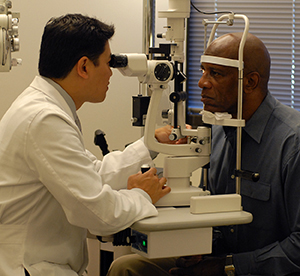
In most cases, you will be given eye drops to widen (dilate) your pupils before your exam. During the exam, the health care provider will look inside your eye using special equipment. This includes a microscope with a bright light (a slit lamp). Your provider will also use a lighted tool (ophthalmoscope) to look at the back part of your eye, called the retina.
Discussing treatment choices
After your eye exam, you and your eye health care provider will talk about your treatment choices. A new eyeglass or contact lens prescription may help your vision for a while. But surgery is the only way to remove a cataract and replace your cloudy lens. You may want to wait to have your cataract removed if you can still do your daily activities without any problems. You and your provider will decide what’s best for you.
Note
If you decide to have cataract surgery, the length of your eye and curvature of your cornea will be measured. This information helps your health care provider choose a new lens to replace your cloudy lens. Measurement is done using special tools. These may include an A-Scan, laser interferometry, a keratometer, or a topographer.
Online Medical Reviewer: Daphne Pierce-Smith RN MSN
Online Medical Reviewer: Sravani Chintapalli Researcher
Online Medical Reviewer: Whitney Seltman MD
Date Last Reviewed: 04/01/2025
© 2000-2026 The StayWell Company, LLC. All rights reserved. This information is not intended as a substitute for professional medical care. Always follow your healthcare professional's instructions.
Need Help? We're Here for You
Our Member Services team is here to help you understand your benefits, find care, or resolve concerns.
1-800-510-9132
Call NC Quitline
Need support to quit smoking, vaping, or to quit other nicotine products? You can receive support including medicines free of charge:
1-800-784-8669
Schedule Transportation
Need transportation to a doctor's office, pharmacy, or other covered healthcare service? Contact us to arrange your ride.
1-800-510-9132
Provider Directory
Need to find a provider like a Primary Care Physician, Specialist, OB/GYN, or a Psychiatrist?
Provider DirectoryRelated Articles
Fluorescein Angiography
Learn about fluorescein angiography, an eye test that lets your healthcare provider examine the back of your eyes.
Preventing Eye Strain at the Computer
If you spend hours each day working at a computer screen or other devices with screens, you may suffer from symptoms of eye strain. Eye strain is a common problem, but you can take steps to reduce your discomfort.
What Is Low Vision?
When you have low vision, you can't see well enough to get around or do daily activities. Regular glasses or contact lenses may not help. Your central or side vision, or both, may be reduced.
Adapting to Age-Related Macular Degeneration
If you have vision loss from macular degeneration, you can continue many of the activities you do now. Vision aids can help you with tasks that need detailed vision. Keep checking your vision and call your eye healthcare provider if you notice any changes.


