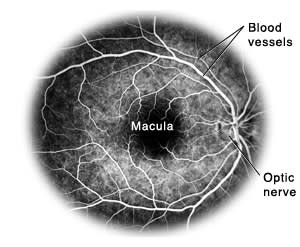
Fluorescein angiography is an eye test. It looks at the back of your eye, including:
- The blood vessels in your eye
- The layer of tissue at the back of your eye (the retina)
- The center of your retina (the macula)
- The optic nerve
This test can diagnose diseases found in these areas. To do this test, a dye called fluorescein is injected into your arm. The dye goes into your bloodstream and up into the blood vessels in your eyes. A special camera is then used to take images (angiograms) of your eyes.
Getting ready for your test
Before anything is done, you will be asked to read and sign a form giving your consent for the procedure. Read the form carefully. Have all your questions answered before you sign it.
Tell your doctor if you:
- Are pregnant or think you may be pregnant
- Are breastfeeding
- Have a history of severe allergic reactions, including to X-ray dye or other medicines
- Have kidney problems
Tell your doctor about any recent health problems and any medicines you are taking. You may need to stop taking all or some of these before the test. This includes:
- All prescription medicines
- Over-the-counter medicines, such as aspirin or ibuprofen
- Illegal drugs
- Herbs, vitamins, and other supplements
You should arrange for an adult family member or friend to drive you home after your test. Your vision will be blurry for up to 12 hours.
Follow any other instructions from your doctor.
During your test
Here is what to expect:
- You are given eye drops to enlarge (dilate) your pupils.
- You then sit in front of a special camera. You place your chin on the chin rest and look into the camera.
- Images are taken of your eyes, one eye at a time.
- Fluorescein dye is then injected into your arm. The lights in the room are turned off. You may have mild nausea. You may have a warm feeling in your arm or upper body. Tell your doctor if your skin feels itchy or if you are having trouble breathing. If so, you could be having an allergic reaction to the dye.
- More pictures of your eyes are taken over about 15 minutes. The camera shines a bright light into your eyes. Try to keep your head still and your eyes open.
- When enough images have been taken, the test is over.
After your test
Your vision will be blurry for up to 4 to 12 hours. This is because of your dilated pupils. Your eyes will be more sensitive to light for up to 12 hours. You may want to wear sunglasses during this time. Don't drive if your vision is very blurry. You may also find it hard to read. Your skin may look yellow for a few hours. This is from the dye. Your urine will be dark yellow or orange for 24 to 48 hours.
Risks of the test
All procedures have some risks. Possible risks of fluorescein angiography include:
- Upset stomach (nausea) and vomiting
- Leaking dye around the injection site that causes pain and swelling
- Metallic taste in your mouth
- Infection at injection site
- Allergic reaction to the dye
- Dry mouth or too much saliva
- Faster heart rate
- Sweating
- Low back pain
Online Medical Reviewer: Chris Haupert MD
Online Medical Reviewer: Tara Novick BSN MSN
Online Medical Reviewer: Whitney Seltman MD
Date Last Reviewed: 12/01/2022
© 2000-2026 The StayWell Company, LLC. All rights reserved. This information is not intended as a substitute for professional medical care. Always follow your healthcare professional's instructions.
Need Help? We're Here for You
Our Member Services team is here to help you understand your benefits, find care, or resolve concerns.
1-800-510-9132
Call NC Quitline
Need support to quit smoking, vaping, or to quit other nicotine products? You can receive support including medicines free of charge:
1-800-784-8669
Schedule Transportation
Need transportation to a doctor's office, pharmacy, or other covered healthcare service? Contact us to arrange your ride.
1-800-510-9132
Provider Directory
Need to find a provider like a Primary Care Physician, Specialist, OB/GYN, or a Psychiatrist?
Provider DirectoryRelated Articles
Cataracts: Your Evaluation
An evaluation helps your eye health care provider learn more about your vision problems.
What Is Blepharitis?
Blepharitis is a redness and swelling (inflammation) of the eyelids. The membrane covering the inside of your eyelid and the white of your eye may also become inflamed. It can’t always be cured. But it can be controlled.
Laser Photocoagulation for Age-Related Macular Degeneration (AMD)
Laser photocoagulation is a type of laser surgery used to treat age-related macular degeneration (AMD). AMD is a condition that can lead to vision loss.
Understanding Pneumatic Retinopexy
Pneumatic retinopexy is a procedure to correct a detached retina. It helps to bring back vision. It uses a special tool to repair the retina, and a small bubble of gas to hold the retina in place so it can heal.