If you’ve had bleeding early in your pregnancy, you’re not alone. Many other pregnant women have early bleeding too. And in most cases, nothing is wrong. But your provider still needs to know about it. They may want to do tests to find out why you’re bleeding. Contact your provider if you see bleeding during pregnancy.
What causes early bleeding?
The cause of bleeding early in pregnancy is often unknown. But many factors early in pregnancy may lead to light bleeding (called spotting) or heavier bleeding. These include:
-
Having sex.
-
The fertilized egg attaching on the uterine wall.
-
Bleeding between the amniotic sac and the uterus.
-
Pregnancy loss (miscarriage).
-
The embryo attaching outside of the uterus (ectopic pregnancy).
If you see spotting
Light bleeding is the most common type of bleeding in early pregnancy. If you see it, contact your provider. It's likely that they will tell you that you can care for yourself at home.
If tests are needed
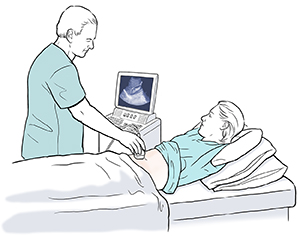
Depending on how much you bleed, your provider may ask you to come in for some tests. A pelvic exam, for instance, can help see how far along your pregnancy is. You also may have an ultrasound or a Doppler test. These imaging tests use sound waves to check the health of your baby. The ultrasound may be done on your belly or inside your vagina.
You may also need a special blood test. This test compares your hormone levels in blood samples taken 2 days apart. The results can help your provider learn more about the implantation of the embryo.
Questions you may be asked
When you tell your provider that you are having some bleeding, they may ask you questions like these to help find the cause of your bleeding:
-
When did your bleeding start?
-
Is your bleeding very light or is it like a period?
-
Is the blood bright red or brownish?
-
Have you had sex recently?
-
Have you had pain or cramping?
-
Have you felt dizzy or faint?
Warning signs
If your bleeding doesn’t stop or if you have any of the following, get medical care right away:
-
Soaking a sanitary pad in one hour or less
-
Bleeding like you’re having a period
-
Cramping or severe belly pain
-
Feeling dizzy or faint
-
Having clots that may contain blood or tissue coming out of your vagina
-
Bleeding at any time after the first trimester
Featured in
Online Medical Reviewer: Donna Freeborn PhD CNM FNP
Online Medical Reviewer: Heather M Trevino BSN RNC
Online Medical Reviewer: Irina Burd MD PhD
Date Last Reviewed: 09/01/2025
© 2000-2026 The StayWell Company, LLC. All rights reserved. This information is not intended as a substitute for professional medical care. Always follow your healthcare professional's instructions.
Need Help? We're Here for You
Our Member and Recipient Services Team is here to help you understand your benefits, find care, or resolve concerns.
800-510-9132
Call NC Quitline
Need support to quit smoking, vaping, or to quit other nicotine products? You can receive support including medicines free of charge:
800-784-8669
Schedule Transportation
Need transportation to a doctor's office, pharmacy, or other covered healthcare service? Contact us to arrange your ride.
800-510-9132
Provider Directory
Need to find a provider like a Primary Care Physician, Specialist, OB/GYN, or a Psychiatrist?
Provider DirectoryRelated Articles
Pregnancy and Childbirth: Fetal Growth Restriction
With fetal growth restriction, the growing baby (fetus) is smaller than normal. This means the baby is not growing at a normal rate. Read on to learn about causes, diagnosis, and treatment.
Hormones During Pregnancy
Many hormone levels are affected in the body during pregnancy, with several hormones playing major roles. Read on to learn more.
Stages of Labor
Your healthcare provider may describe the progress of your labor in terms of your baby's position and station, as well as by the effacement and dilation of your cervix. Learn more about the 3 stages of labor.
Symptoms and Diagnosis of Multiple Pregnancy
Every pregnant woman feels like she’s getting big. But if you’re pregnant with 2 or more babies, you’ll really be growing fast. Be prepared by learning the signs of a multiple birth.


