Labor has 3 stages. Your healthcare provider may talk about the progress of your labor with certain words. One of these is your baby’s position. Another is your baby’s station. And the effacement and dilation of your cervix will be noted. Read below to learn about these terms and the 3 stages of labor.
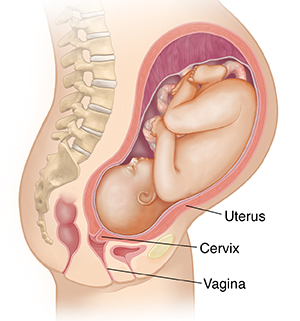
Your baby moves into position
Position is your baby’s placement in your uterus. Your baby may be facing left or right. They may be headfirst or feetfirst. Station refers to how far your baby has moved down into your pelvic cavity.
First stage of labor
During the first stage of labor, contractions of the uterus help your cervix thin (efface). They also help it widen (dilate). This will help your baby pass through the vagina (birth canal). At first your contractions won't come that often or last that long. But as time passes, they will come more often, they may be more painful, and they will last longer. They will last about
Second stage of labor
When your cervix is fully dilated, the second stage of labor begins. In this stage, you will have stronger contractions of your uterus that will help your baby move down the birth canal. They may happen every
Third stage of labor
The third stage of labor comes after your baby is born. This is when the afterbirth (placenta) comes out of your uterus. Your uterus will continue to contract. But the contractions are much milder than before.
Featured in
Online Medical Reviewer: Donna Freeborn PhD CNM FNP
Online Medical Reviewer: Heather M Trevino BSN RNC
Online Medical Reviewer: Irina Burd MD PhD
Date Last Reviewed: 09/01/2025
© 2000-2026 The StayWell Company, LLC. All rights reserved. This information is not intended as a substitute for professional medical care. Always follow your healthcare professional's instructions.
Need Help? We're Here for You
Our Member and Recipient Services Team is here to help you understand your benefits, find care, or resolve concerns.
800-510-9132
Call NC Quitline
Need support to quit smoking, vaping, or to quit other nicotine products? You can receive support including medicines free of charge:
800-784-8669
Schedule Transportation
Need transportation to a doctor's office, pharmacy, or other covered healthcare service? Contact us to arrange your ride.
800-510-9132
Provider Directory
Need to find a provider like a Primary Care Physician, Specialist, OB/GYN, or a Psychiatrist?
Provider DirectoryRelated Articles
Pregnancy: Your Second Trimester Changes
Even when you don’t notice it, your body is adapting to meet the needs of your growing baby. The changes in your body might also affect your moods.
Dilation and Curettage (D and C)
Dilation and curettage or D&C is surgery to remove abnormal tissues in the uterus.
Back Pain During Pregnancy: Positioning Yourself
Did you know that standing, sitting, or lying in certain ways can lead to back pain? To ease pain, use positions that support your body comfortably.
Bleeding During Early Pregnancy
Bleeding early in pregnancy isn't uncommon. In most cases, nothing is wrong. Still, it's a good idea to let your provider know if it happens.