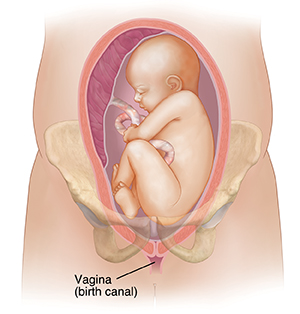
Breech presentation means that your baby is in a buttocks-first or feet-first position. Babies are usually in a head-first position. A breech position can make it hard for the baby’s head to fit through the birth canal during delivery. This can cause lack of oxygen or nerve damage in your baby.
Checking for breech presentation
Your doctor can tell that your baby is in a breech presentation by gently pressing on your belly. If after about 36 weeks your baby still isn’t head-first, you may have a test called an ultrasound. This test uses sound waves to form an image of your baby on a screen.
Types of breech presentations
As you get close to your due date, your baby may be in one of these breech positions:
-
Frank breech. The baby's buttocks are closest to the birth canal. The hips are flexed, and the legs are straight up in front of the body. The feet are near the baby's head.
-
Complete breech. The baby's knees are bent, and the feet and buttocks are closest to the birth canal.
-
Incomplete breech. One or both of the baby's feet are closest to the birth canal.
Delivering your baby
Even if the baby’s position can’t be changed, a breech baby can sometimes be born vaginally. But this is rare. Your doctor will talk with you about the risks. More often, a surgical delivery (cesarean section or C-section) is done. You will have medicine to block pain (anesthesia). But you may stay awake and alert. You will have an ultrasound at the hospital to confirm the position of your baby (the fetus) just before the surgery.
After you deliver
Whether you give birth vaginally or by C-section, you and your baby will most likely be fine. Just because your baby is in a breech position doesn’t mean that they will have health problems.
Can you have a vaginal delivery?
In some cases, your doctor may try to turn the baby head-down by putting pressure on your belly. This method is called an external cephalic version. It is usually tried after 36 weeks. If this works, you might be able to have a vaginal delivery. Your doctor will talk about this with you.
Note: External cephalic version cannot be done after active labor has started.
Online Medical Reviewer: Daphne Pierce-Smith RN MSN
Online Medical Reviewer: Tennille Dozier RN BSN RDMS
Online Medical Reviewer: Vinita Wadhawan Researcher
Date Last Reviewed: 06/01/2025
© 2000-2026 The StayWell Company, LLC. All rights reserved. This information is not intended as a substitute for professional medical care. Always follow your healthcare professional's instructions.
Need Help? We're Here for You
Our Member Services team is here to help you understand your benefits, find care, or resolve concerns.
1-800-510-9132
Call NC Quitline
Need support to quit smoking, vaping, or to quit other nicotine products? You can receive support including medicines free of charge:
1-800-784-8669
Schedule Transportation
Need transportation to a doctor's office, pharmacy, or other covered healthcare service? Contact us to arrange your ride.
1-800-510-9132
Provider Directory
Need to find a provider like a Primary Care Physician, Specialist, OB/GYN, or a Psychiatrist?
Provider DirectoryRelated Articles
Anemia During Pregnancy
Anemia during pregnancy is often caused by not having enough iron in the blood. It is common in pregnancy and very easy to treat.
Oligohydramnios
Read on to learn about oligohydramnios, including causes, diagnosis, and how to manage it.
PUPPP (Pruritic Urticarial Papules and Plaques of Pregnancy)
PUPPP is a very common skin rash that can occur later in pregnancy. It goes away after the baby is born. Learn about how you can ease the itching it causes.
Hyperemesis Gravidarum
Hyperemesis gravidarum is a severe form of morning sickness that can affect some women during pregnancy. Symptoms include severe nausea and vomiting.


