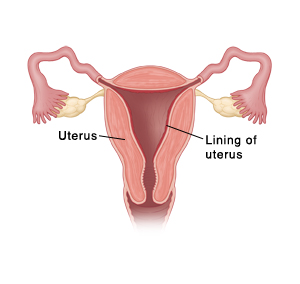
Menstruation occurs when a woman sheds the lining of her uterus. It's also called a period. For most women, this happens once a month. But some women may not get their periods. This is called amenorrhea.
Amenorrhea may be due to a number of causes. These include:
-
Pregnancy, breastfeeding, or menopause.
-
Hormone problems.
-
Emotional stress.
-
Very low body weight.
-
Exercising too much.
-
Poor nutrition or eating disorders.
-
Taking certain medicines.
-
Having certain birth defects or genetic disorders.
There are 2 types of amenorrhea:
-
Primary amenorrhea. This is when a female has not had her first period by age 15.
-
Secondary amenorrhea. This is when:
-
A female who has been having normal periods stops getting them for 3 months in a row.
-
A female who has been having irregular periods stops getting them for 6 months in a row.
-
One or more tests can be done to find out why you’re not having periods. These include blood tests and imaging tests. Once the cause is found, it may be treated. Treatments can range from lifestyle and diet changes to medicines, procedures, or surgery. Your doctor will discuss choices with you as needed.
Follow-up care
Follow up with your doctor as advised. You'll be told the results of any tests as soon as they are ready.
Pregnancy
Note: Know that you can still become pregnant even if you are not having regular periods. It's important to use some form of birth control if you are sexually active and don't want to get pregnant.
When to get medical advice
Contact your doctor right away if you have:
-
Severe pain in the belly (abdomen).
-
Belly swelling.
-
Sudden, severe vaginal bleeding.
-
Feeling faint or passing out.
Featured in
Online Medical Reviewer: Donna Freeborn PhD CNM FNP
Online Medical Reviewer: Heather M Trevino BSN RNC
Online Medical Reviewer: Irina Burd MD PhD
Date Last Reviewed: 07/01/2025
© 2000-2026 The StayWell Company, LLC. All rights reserved. This information is not intended as a substitute for professional medical care. Always follow your healthcare professional's instructions.
Need Help? We're Here for You
Our Member and Recipient Services Team is here to help you understand your benefits, find care, or resolve concerns.
800-510-9132
Call NC Quitline
Need support to quit smoking, vaping, or to quit other nicotine products? You can receive support including medicines free of charge:
800-784-8669
Schedule Transportation
Need transportation to a doctor's office, pharmacy, or other covered healthcare service? Contact us to arrange your ride.
800-510-9132
Provider Directory
Need to find a provider like a Primary Care Physician, Specialist, OB/GYN, or a Psychiatrist?
Provider DirectoryRelated Articles
Urethral Stricture
Narrowing or blockage of the urethra is known as a urethral stricture. This is more common in men than in women.
Understanding the Normal Menstrual Cycle
A normal menstrual cycle is described. And it's rare but possible to become pregnant during your period, especially if your cycle is irregular.
Pelvic Ultrasound
Pelvic ultrasound is an imaging test that uses sound waves to form pictures of your organs. It can help assess pain or other symptoms within your pelvis. In pregnant women, it is used to check the health of the unborn baby.
Understanding Straddle Injury
A straddle injury is when an injury occurs to the groin area between the thighs. Learn more about this type of injury, including cause, symptoms, diagnosis, and treatment.


