Cortisone is a type of steroid. It can greatly reduce swelling, redness, inflammation, and pain. Being injected with cortisone is simple and doesn’t take long. Your healthcare provider may ask you questions about your health. Cortisone can affect certain health conditions, such as diabetes.
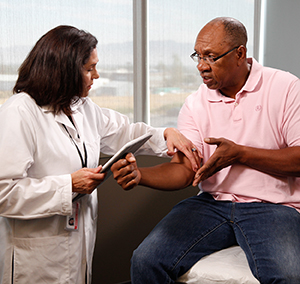
Why have a cortisone injection?
Injecting cortisone can sometimes relieve pain for anything from a sports injury to arthritis. Your healthcare provider may suggest an injection if rest, splints, physical therapy, rehabilitation exercises, or oral medicine doesn’t relieve your pain. Injecting cortisone is simpler than having surgery. And cortisone may provide the lasting pain relief that can help you get out and enjoy life again. Be sure to discuss all choices with your healthcare provider. Injections are usually used no more than 3 to 4 times a year in 1 area of the body.
Getting the injection
Your healthcare provider will start by cleaning and possibly numbing your skin at the injection site. Next you’ll be injected with local anesthetics (for short-term pain relief) and cortisone. The injection may last a few moments. A small bandage will be put over the injection site. You’ll then be ready to go home.
After your injection
After being injected, make sure you don’t injure the treated region. But stay active. Enjoy a walk or some other mild activity. Just be careful not to strain the region that gave you trouble.
The next day
Some people feel more pain after being injected. This is normal, and it will go away soon. Applying ice for
Cortisone injections and diabetes
Cortisone injections can increase your blood sugar for several days after the injection. If you have diabetes, watch your blood sugar closely during this time. Follow your regular plan for what to do when your blood sugar is elevated.
Online Medical Reviewer: Raymond Turley Jr PA-C
Online Medical Reviewer: Stacey Wojcik MBA BSN RN
Online Medical Reviewer: Thomas N Joseph MD
Date Last Reviewed: 08/01/2022
© 2000-2026 The StayWell Company, LLC. All rights reserved. This information is not intended as a substitute for professional medical care. Always follow your healthcare professional's instructions.
Need Help? We're Here for You
Our Member Services team is here to help you understand your benefits, find care, or resolve concerns.
1-800-510-9132
Call NC Quitline
Need support to quit smoking, vaping, or to quit other nicotine products? You can receive support including medicines free of charge:
1-800-784-8669
Schedule Transportation
Need transportation to a doctor's office, pharmacy, or other covered healthcare service? Contact us to arrange your ride.
1-800-510-9132
Provider Directory
Need to find a provider like a Primary Care Physician, Specialist, OB/GYN, or a Psychiatrist?
Provider DirectoryRelated Articles
Before Arthroscopy
Here's what to know before you have arthroscopy.
Foot Surgery: Curled Fifth Toe
A curled fifth toe is most often inherited. When the fifth toe curls inward, it moves under the next toe. Then the nail of the curled toe starts to face outward. As a result, you may bear weight on the side of your toe instead of the bottom. This can cause corns and painful nails. There are many nonsurgical treatments available. But if these are not effective, surgery is a choice.
Understanding Achilles Tendon Repair Surgery
Achilles tendon repair surgery is a type of surgery to fix a damaged Achilles tendon.
Treating Ganglia
A ganglion is a cystic swelling that is found in overlying joint and tendon sheaths, especially of the wrist. The foot and other extremity areas are sometimes involved. Ganglia can be treated surgically and nonsurgically.


