A problem with your facet joints can cause pain. This pain may be in your low back, middle back, or neck. If so, a facet joint injection may help. These injections are often used when pain is caused by a condition that gets worse over time (degenerative). And they are often used for arthritic conditions or injury. With this treatment, medicine is injected directly into certain facet joints. It can be done to diagnose an issue. Or it can be done to relieve pain.
What is a facet joint?
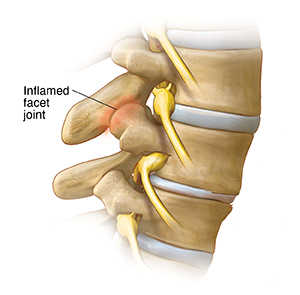
Bones called vertebrae make up your spine. Each bone in your spine (vertebra) has flat surfaces (facets) that touch where the bones fit together. These form a structure called a facet joint. This is a small joint located between each vertebra on the back of the spine.
What is a facet joint injection?
One or more facet joints in your back or neck can become swollen and irritated (inflamed). This may cause pain. You may have medicine injected directly into the inflamed joints. This treatment is called a facet joint injection. It may help reduce inflammation. And it may help relieve pain. Pain relief may last for weeks, months, or longer. If the pain returns, you may need another injection.
Getting ready
To get ready for your treatment, do the following:
-
Tell your health care provider what medicines you take. Do this at least 1 week before treatment. This includes prescription and over-the-counter medicines. It includes aspirin as well as vitamins, herbs, and other supplements. Ask if you should stop taking any of them before treatment.
-
Tell your provider if you are allergic to any medicines.
-
Tell your provider if you are pregnant or could be pregnant.
-
Follow any directions you are given for not eating or drinking before the treatment.
-
If asked, bring tests with you on the day of your treatment. This includes X-rays and imaging scans like MRIs.
Online Medical Reviewer: Marianne Fraser MSN RN
Online Medical Reviewer: Michelle Johnson BSN RN AMB-BC
Online Medical Reviewer: Rita Sather RN
Date Last Reviewed: 03/01/2025
© 2000-2026 The StayWell Company, LLC. All rights reserved. This information is not intended as a substitute for professional medical care. Always follow your healthcare professional's instructions.
Need Help? We're Here for You
Our Member and Recipient Services Team is here to help you understand your benefits, find care, or resolve concerns.
800-510-9132
Call NC Quitline
Need support to quit smoking, vaping, or to quit other nicotine products? You can receive support including medicines free of charge:
800-784-8669
Schedule Transportation
Need transportation to a doctor's office, pharmacy, or other covered healthcare service? Contact us to arrange your ride.
800-510-9132
Provider Directory
Need to find a provider like a Primary Care Physician, Specialist, OB/GYN, or a Psychiatrist?
Provider DirectoryRelated Articles
Your Amputation Surgery
Amputation is surgery to remove a limb. Learn about the surgery and what to expect after.
Foot Surgery: Bunions
A bunion is a bony bump. When the distance between the first and second metatarsal bones of the foot is greater than normal, the big toe may turn toward the other toes. A mild bunion may then form causing foot pain and swelling. Bunions are most often found near the joint at the base of the big toe. Bunions tend to run in families. They may cause pain, swelling, and skin irritation.
Shoulder Joint Surgery: SLAP Repair
A SLAP lesion is a shoulder injury. It happens when there is a tear in the labrum. This is the fibrous cartilage that helps hold the shoulder joint in place. Surgery can repair this injury.
Understanding Transforaminal Lumbar Interbody Fusion (TLIF)
A fusion is a surgery to join two or more bones together. During a transforaminal lumbar interbody fusion (TLIF), this is done on the spine. Learn more about why and how TLIF is done and what the risks are.