Low back and leg pain is often because of damage to 1 or more of the disks between the vertebrae. Electrothermal therapy uses heat to change the structure of the tissue inside the disk. It doesn’t relieve pain right away. Pain is reduced as the disk heals. After healing, the disk may also be stronger and more stable than before. This treatment is also called intradiscal electrothermal therapy.
Inside the disk
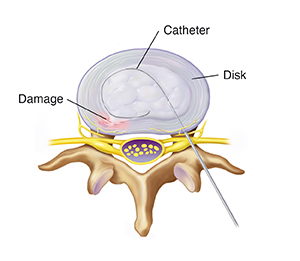
First, a needle is inserted into the disk. Then a special flexible wire (catheter) is threaded through the needle, so that it curves around the inside of the disk. When the catheter is in place, part of it is next to the damage in the disk.
Heating the disk
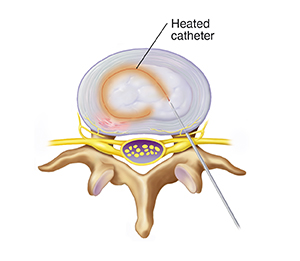
Once the catheter is in place, it's heated slowly to a high temperature. The catheter is kept at that temperature for a few minutes. Then it's removed. The heat may deaden nerves in the disk, preventing these nerves from causing pain. The heat may also make the disk shrink. This may mean that the disk no longer presses on nerves. The heated tissue will slowly heal over the next few months and form scar tissue. This scar tissue may:
-
Plug any leak in the disk
-
Make the disk stronger
Risks and possible complications
The risks and complications of electrothermal catheter therapy include:
-
Bleeding
-
Spinal fluid leak
-
Infection
-
Nerve damage
-
Worsened pain after recovery
-
No improvement of pain
Online Medical Reviewer: Jimmy Moe MD
Online Medical Reviewer: Ronald Karlin MD
Online Medical Reviewer: Tara Novick
Date Last Reviewed: 09/01/2024
© 2000-2026 The StayWell Company, LLC. All rights reserved. This information is not intended as a substitute for professional medical care. Always follow your healthcare professional's instructions.
Need Help? We're Here for You
Our Member Services team is here to help you understand your benefits, find care, or resolve concerns.
1-800-510-9132
Call NC Quitline
Need support to quit smoking, vaping, or to quit other nicotine products? You can receive support including medicines free of charge:
1-800-784-8669
Schedule Transportation
Need transportation to a doctor's office, pharmacy, or other covered healthcare service? Contact us to arrange your ride.
1-800-510-9132
Provider Directory
Need to find a provider like a Primary Care Physician, Specialist, OB/GYN, or a Psychiatrist?
Provider DirectoryRelated Articles
Understanding Knee Replacement
The knee is a hinge-like joint, formed where the thighbone, shinbone, and kneecap meet. Over time, cartilage can wear away and the knee becomes stiff and painful. An artificial knee joint can replace the painful joint and restore movement. Learn more about the joints and knee replacement surgery.
Ankle Arthroscopy: Conditions Treated
Arthroscopy is used to find and treat ankle problems. These include loose bodies, bone spurs, osteochondritis dissecans (OCD), and synovitis.
Having Posterior Tibialis Tendon Surgery
Posterior tibialis tendon surgery is a way to fix the tendon on the back of your calf that goes down the inside part of your ankle.
Bunion Surgery
Bunion surgery is done to reduce the pain and correct the deformity caused by a bunion. A bunion is an enlargement of the bone or tissue around a joint at the base of the big toe or at the base of the little toe. Read on for details about this surgery.


