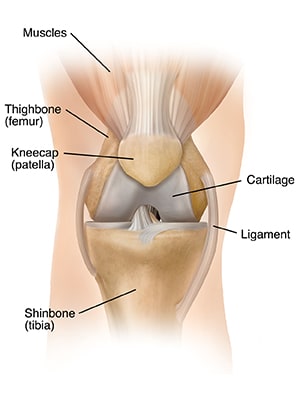
The knee is a joint that works like a hinge. It is formed where the thighbone (femur), shinbone (tibia), and kneecap (patella) meet. It is supported by muscles, tendons, and ligaments. It is also lined with cushioning cartilage. Over time, cartilage can wear away. As it does, the knee becomes stiff and painful. An artificial knee joint (prosthesis) can replace the painful joint and restore movement.
A healthy knee
A healthy knee joint bends easily. Cartilage is a smooth tissue. It covers the ends of the thighbone and shinbone and the underside of the kneecap. Healthy cartilage absorbs stress and allows the bones to glide freely over each other. Joint fluid lubricates the cartilage surfaces, making movement even easier.
A problem knee
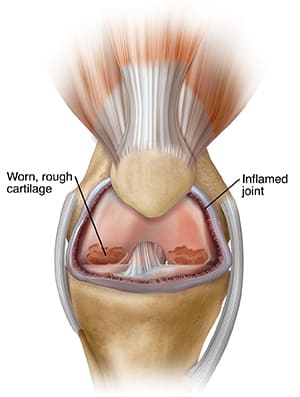
A problem knee is often stiff and painful. Cartilage cracks or wears away due to usage, inflammation, or injury. Worn, roughened cartilage no longer lets the joint glide freely. So it feels stiff and painful. As more cartilage wears away, exposed bones rub together when the knee bends, causing pain. With time, bone surfaces also become rough, making pain worse.
A knee prosthesis
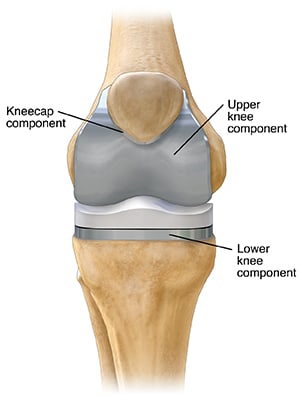
A knee prosthesis lets your knee bend easily again. The roughened ends of the thighbone and shinbone and the underside of the kneecap are replaced with metal and strong plastic parts. With new smooth surfaces, the bones can once again glide freely without pain. A knee prosthesis does have limits. But it can let you walk and move with greater comfort.
Online Medical Reviewer: L Renee Watson MSN RN
Online Medical Reviewer: Raymond Turley Jr PA-C
Online Medical Reviewer: Thomas N Joseph MD
Date Last Reviewed: 09/01/2025
© 2000-2026 The StayWell Company, LLC. All rights reserved. This information is not intended as a substitute for professional medical care. Always follow your healthcare professional's instructions.
Need Help? We're Here for You
Our Member and Recipient Services Team is here to help you understand your benefits, find care, or resolve concerns.
800-510-9132
Call NC Quitline
Need support to quit smoking, vaping, or to quit other nicotine products? You can receive support including medicines free of charge:
800-784-8669
Schedule Transportation
Need transportation to a doctor's office, pharmacy, or other covered healthcare service? Contact us to arrange your ride.
800-510-9132
Provider Directory
Need to find a provider like a Primary Care Physician, Specialist, OB/GYN, or a Psychiatrist?
Provider DirectoryRelated Articles
Your Amputation Surgery
Amputation is surgery to remove a limb. Learn about the surgery and what to expect after.
Foot Surgery: Bunions
A bunion is a bony bump. When the distance between the first and second metatarsal bones of the foot is greater than normal, the big toe may turn toward the other toes. A mild bunion may then form causing foot pain and swelling. Bunions are most often found near the joint at the base of the big toe. Bunions tend to run in families. They may cause pain, swelling, and skin irritation.
Shoulder Joint Surgery: SLAP Repair
A SLAP lesion is a shoulder injury. It happens when there is a tear in the labrum. This is the fibrous cartilage that helps hold the shoulder joint in place. Surgery can repair this injury.
Understanding Transforaminal Lumbar Interbody Fusion (TLIF)
A fusion is a surgery to join two or more bones together. During a transforaminal lumbar interbody fusion (TLIF), this is done on the spine. Learn more about why and how TLIF is done and what the risks are.