Reverse total shoulder replacement is a type of shoulder surgery. It’s usually done to repair the shoulder joint if you have a completely torn rotator cuff with shoulder arthritis.
Understanding the shoulder joint
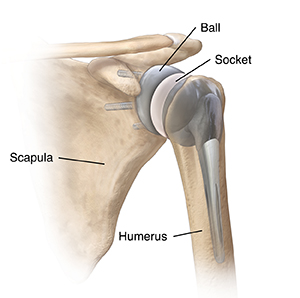
The shoulder joint is where the ball-shaped part of the upper arm bone (humerus) meets the cup-shaped socket of the shoulder blade (scapula). A group of muscles and tendons hold the joint together. These muscles and tendons are called the rotator cuff. The muscles let you move your arm and shoulder.
Why reverse total shoulder replacement is done
The surgery may be needed if you have a complete tear of your rotator cuff. The tear may cause long-term problems with your shoulder joint. This is called cuff tear arthropathy. You may need reverse total shoulder replacement surgery if you have:
-
A complete tear in your rotator cuff.
-
Joint problems from the cuff tear (cuff tear arthropathy).
-
Symptoms that didn't go away after a previous total shoulder replacement surgery.
-
Severe pain and trouble moving your shoulder.
-
No relief with treatments such as rest, medicines, cortisone injections, or physical therapy.
How reverse total shoulder replacement is done
The surgery is the opposite (reverse) of standard total shoulder replacement surgery:
-
In the standard surgery, the ball of the humerus is replaced with an artificial ball. The socket of the scapula is replaced with an artificial socket. The new joint still uses the rotator cuff muscles to move the arm and shoulder.
-
With the reverse surgery, the ball of the humerus is replaced with an artificial socket. The socket of the scapula is replaced with an artificial ball. Since the rotator cuff muscles are damaged, another muscle (deltoid) moves the arm and shoulder.
Risks of reverse total shoulder replacement
Every surgery has risks. Risks for this surgery include:
-
Infection.
-
Blood loss.
-
Damage to nerves that may make it hard to move your arm.
-
Damage to the humerus or scapula.
-
The artificial joint moving out of position (dislocation).
-
Stiffness, pain, and limited function.
-
Problems with anesthesia.
Some risks may be higher if you've had shoulder surgery in the past. Your risks may vary depending on your shoulder problem and your overall health. Talk with your doctor about which risks apply most to you.
Online Medical Reviewer: Raymond Turley Jr PA-C
Online Medical Reviewer: Tara Novick BSN MSN
Online Medical Reviewer: Thomas N Joseph MD
Date Last Reviewed: 05/01/2025
© 2000-2026 The StayWell Company, LLC. All rights reserved. This information is not intended as a substitute for professional medical care. Always follow your healthcare professional's instructions.
Need Help? We're Here for You
Our Member Services team is here to help you understand your benefits, find care, or resolve concerns.
1-800-510-9132
Call NC Quitline
Need support to quit smoking, vaping, or to quit other nicotine products? You can receive support including medicines free of charge:
1-800-784-8669
Schedule Transportation
Need transportation to a doctor's office, pharmacy, or other covered healthcare service? Contact us to arrange your ride.
1-800-510-9132
Provider Directory
Need to find a provider like a Primary Care Physician, Specialist, OB/GYN, or a Psychiatrist?
Provider DirectoryRelated Articles
Hip Arthroscopy: Before Surgery
Learn more about hip arthroscopy and what you can do before your surgery.
Neck Problems: Relieving Your Symptoms
These self-care treatments can help ease your neck pain.
Spinal Fusion
During spinal fusion, your surgeon locks together, or fuses, certain bones in your spine that are causing pain. This limits the movement of these bones, which may help ease your pain. Even so, you may feel more flexible after a fusion because you can move with less pain.
Having a Bone Graft
Bone grafting is surgery to repair and rebuild bones that are damaged or diseased. This surgery can be done to fix bones almost anywhere in your body.