Charcot foot is also called diabetic foot. The only way to stop the progression of it is to stay off the foot long enough for it to heal. Your doctor will prescribe treatment to help healing.
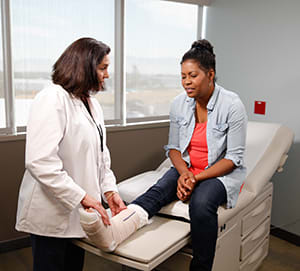
Staying non-weight-bearing
While fractures are healing, it is crucial that you keep your weight off your foot. This is called non-weight-bearing. Your doctor may ask you not to walk at all. Or they may prescribe a special device, such as crutches. Remember: You often don't feel pain with Charcot foot. So even if you feel fine, stay off your foot until your doctor says it's okay.
Using special devices
Special devices may help you keep weight off your foot. That way, your bones can heal smoothly. A wheelchair, crutches, or brace may be prescribed alone or with a cast. A Charcot restraint orthotic walker (CROW) may be prescribed. This is a custom rigid boot. It lets you keep putting weight on your foot. But it also protects your foot. Other devices may be prescribed to help you keep your foot raised while at home. An elastic bandage wrap or special stocking may also be advised. This compresses your foot to reduce swelling and aid healing.
Using custom footwear
Once your foot has healed, you may be fitted for custom shoes or inserts (orthoses). Custom footwear is specially made to fit the shape of your foot. This can help prevent ulcers caused by the rubbing from store-bought shoes. If custom footwear doesn't stop ulcers from forming, surgery may be needed to correct the deformity causing the ulcers.
It's important to look at your feet carefully every day. This includes looking between your toes and at the bottom of your feet. Call your doctor right away if any area on your foot shows irritation or stays red for more than 30 minutes after you take off a special device, such as a CROW or a brace.
Online Medical Reviewer: Anne Fetterman RN BSN
Online Medical Reviewer: Marianne Fraser MSN RN
Online Medical Reviewer: Rita Sather RN
Date Last Reviewed: 03/01/2024
© 2000-2026 The StayWell Company, LLC. All rights reserved. This information is not intended as a substitute for professional medical care. Always follow your healthcare professional's instructions.
Need Help? We're Here for You
Our Member Services team is here to help you understand your benefits, find care, or resolve concerns.
1-800-510-9132
Call NC Quitline
Need support to quit smoking, vaping, or to quit other nicotine products? You can receive support including medicines free of charge:
1-800-784-8669
Schedule Transportation
Need transportation to a doctor's office, pharmacy, or other covered healthcare service? Contact us to arrange your ride.
1-800-510-9132
Provider Directory
Need to find a provider like a Primary Care Physician, Specialist, OB/GYN, or a Psychiatrist?
Provider DirectoryRelated Articles
Kyphoplasty
Kyphoplasty is a procedure that can help relieve the pain of vertebral compression fracture (a collapse of bone in your spine most commonly caused by osteoporosis).
Neck Problems: Relieving Your Symptoms
These self-care treatments can help ease your neck pain.
Exercises Before Hip Replacement: To Help with Walker or Crutch Use
These exercises help build upper body strength.
Spinal Fusion
During spinal fusion, your surgeon locks together, or fuses, certain bones in your spine that are causing pain. This limits the movement of these bones, which may help ease your pain. Even so, you may feel more flexible after a fusion because you can move with less pain.


