The goal of your treatment for de Quervain's tenosynovitis (say "duh-kair-VANZ ten-oh-sin-uh-VY-tus") is to ease your pain and allow you to use your thumb again. Treatment will depend on how bad the pain is.
Nonsurgical treatment
Just taking a break from the activities that caused your pain may be enough. Your doctor may also have you take nonsteroidal, anti-inflammatory drugs, such as ibuprofen. You may also wear a splint for a few weeks to rest the thumb and wrist. To ease swelling, your doctor may inject an anti-inflammatory medicine, such as cortisone around the tendons.
You may have more pain at first. But in a few days your thumb should feel better. Physical therapy or therapy with an occupational therapist or certified hand therapist is often helpful as well.
Surgery
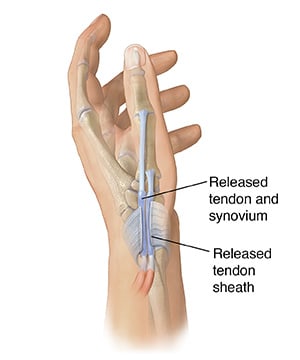
If other kinds of treatment don't ease your pain, or if the pain is bad, you may need surgery. The sheath that surrounds the tendons is released so the tendons can move more easily. This helps reduce the inflammation. It also allows you to straighten your thumb without pain.
Surgery is done with local or regional anesthetic on an outpatient basis, so you can go home the same day. You will likely have a splint or dressing on your wrist for a few days while the tissue heals. You may need physical therapy to help make the muscles strong. Your doctor will talk with you about the risks and possible problems of having surgery.
Online Medical Reviewer: Joseph, Thomas N., MD
Online Medical Reviewer: Sather, Rita, RN
Date Last Reviewed: 09/01/2025
© 2000-2026 The StayWell Company, LLC. All rights reserved. This information is not intended as a substitute for professional medical care. Always follow your healthcare professional's instructions.
Need Help? We're Here for You
Our Member and Recipient Services Team is here to help you understand your benefits, find care, or resolve concerns.
800-510-9132
Call NC Quitline
Need support to quit smoking, vaping, or to quit other nicotine products? You can receive support including medicines free of charge:
800-784-8669
Schedule Transportation
Need transportation to a doctor's office, pharmacy, or other covered healthcare service? Contact us to arrange your ride.
800-510-9132
Provider Directory
Need to find a provider like a Primary Care Physician, Specialist, OB/GYN, or a Psychiatrist?
Provider DirectoryRelated Articles
Understanding Transforaminal Lumbar Interbody Fusion (TLIF)
A fusion is a surgery to join two or more bones together. During a transforaminal lumbar interbody fusion (TLIF), this is done on the spine. Learn more about why and how TLIF is done and what the risks are.
Your Amputation Surgery
Amputation is surgery to remove a limb. Learn about the surgery and what to expect after.
Foot Surgery: Bunions
A bunion is a bony bump. When the distance between the first and second metatarsal bones of the foot is greater than normal, the big toe may turn toward the other toes. A mild bunion may then form causing foot pain and swelling. Bunions are most often found near the joint at the base of the big toe. Bunions tend to run in families. They may cause pain, swelling, and skin irritation.
Shoulder Joint Surgery: SLAP Repair
A SLAP lesion is a shoulder injury. It happens when there is a tear in the labrum. This is the fibrous cartilage that helps hold the shoulder joint in place. Surgery can repair this injury.