To treat a frozen shoulder, stretches are tried first. If stretches alone don’t help, your healthcare provider may suggest adding other treatments. Keep in mind that no treatment replaces shoulder stretches. After any of these treatments, you’ll need to start your exercises again as your healthcare provider advises.
Injection therapy
Your healthcare provider may suggest injection therapy. This does not cure frozen shoulder. But it may reduce pain so that you can do your stretches more comfortably. The injection typically includes two medicines. One is an anesthetic to numb the shoulder. The other is a steroid, such as cortisone, to help reduce painful swelling. It can take from a few hours to a couple of days before the injection starts to have an effect.
Surgical treatment
Surgery may be advised if stretching doesn’t relieve your pain and stiffness. In some cases, both procedures described below are done at the same time:
-
Manipulation. Your healthcare provider slowly raises your arm until the adhesions in the capsule are freed (released). The capsule is the sheet of tough fibers surrounding the bones that make up the shoulder joint.
-
Capsular release. Your provider frees the capsule adhesions through a cut (incision). This may be done if manipulation did not release the capsule. Surgery on the shoulder may be done through a few small incisions. This is called arthroscopic surgery. Or it may be done through one large incision. This is known as open surgery.
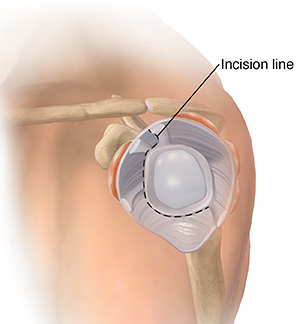
You may start doing shoulder stretches soon after manipulation and capsular release—perhaps even the same day. Your healthcare provider will discuss the plan for your treatment and stretches before the procedure.
Online Medical Reviewer: Joseph, Thomas N., MD
Online Medical Reviewer: Larson, Kim APRN, FNP
Date Last Reviewed: 04/01/2024
© 2000-2026 The StayWell Company, LLC. All rights reserved. This information is not intended as a substitute for professional medical care. Always follow your healthcare professional's instructions.
Need Help? We're Here for You
Our Member and Recipient Services Team is here to help you understand your benefits, find care, or resolve concerns.
800-510-9132
Call NC Quitline
Need support to quit smoking, vaping, or to quit other nicotine products? You can receive support including medicines free of charge:
800-784-8669
Schedule Transportation
Need transportation to a doctor's office, pharmacy, or other covered healthcare service? Contact us to arrange your ride.
800-510-9132
Provider Directory
Need to find a provider like a Primary Care Physician, Specialist, OB/GYN, or a Psychiatrist?
Provider DirectoryRelated Articles
Trigger Point Injection
If you have muscle pain or spasms, it may be due to a trigger point, which is a tight, painful knot of muscle fiber. Your health care provider can inject medicine into the trigger point to ease pain.
Arthroscopy
Orthopedic surgeons use arthroscopy to diagnose and treat joint problems. An arthroscope is a small, tube shaped instrument that is used to look inside a joint.
Understanding Knee Replacement
The knee is a hinge-like joint, formed where the thighbone, shinbone, and kneecap meet. Over time, cartilage can wear away and the knee becomes stiff and painful. An artificial knee joint can replace the painful joint and restore movement. Learn more about the joints and knee replacement surgery.
Ankle Arthroscopy: Conditions Treated
Arthroscopy is used to find and treat ankle problems. These include loose bodies, bone spurs, osteochondritis dissecans (OCD), and synovitis.