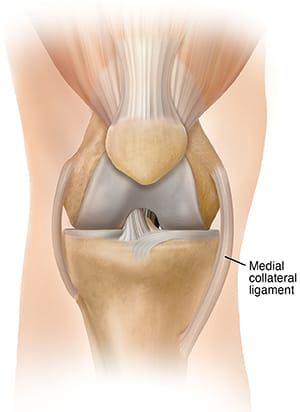
Treatment for an MCL injury can be nonsurgical or surgical. Nonsurgical treatment is used much more often. With either one, rehab will be part of your treatment.
Nonsurgical treatment
This treatment starts with rest, ice, and elevation. This eases pain and swelling. In the next stage, you start exercises to improve your knee's range of motion, strength, and flexibility. You may need a brace for weeks after your injury. Using crutches or a brace rests your joint, helping it to heal.
Surgery
Surgery is seldom used to fix an MCL injury. But sometimes it is advised, especially if some other part of your knee is hurt. Open surgery is used to screw or stitch the MCL back into place. If fixing the original MCL is not possible, an MCL graft may be used. Based on their location, other knee injuries may be fixed using arthroscopy. With arthroscopy, a tiny camera lets your doctor see inside the joint. Tools are put in through small cuts to fix the joint.
Pre-op checklist
- Stop taking aspirin and other medicines
7 days before surgery, or as your doctor directs. - Arrange to get correctly sized crutches to use as you heal.
- Don't eat or drink
10 to 12 hours before surgery, or as your doctor directs. - Arrange for someone to drive you home after surgery.
After surgery
Right after surgery, you'll spend a few hours in a recovery unit. Your knee will be bandaged. Ice will be applied, and your leg raised. Depending on the surgery performed, physical therapy may start shortly after. A brace and crutches are often used after surgery. You may have limits on weight bearing and activity while you heal.
Online Medical Reviewer: Rahul Banerjee MD
Online Medical Reviewer: Raymond Turley Jr PA-C
Online Medical Reviewer: Stacey Wojcik MBA BSN RN
Date Last Reviewed: 09/01/2025
© 2000-2026 The StayWell Company, LLC. All rights reserved. This information is not intended as a substitute for professional medical care. Always follow your healthcare professional's instructions.
Need Help? We're Here for You
Our Member Services team is here to help you understand your benefits, find care, or resolve concerns.
1-800-510-9132
Call NC Quitline
Need support to quit smoking, vaping, or to quit other nicotine products? You can receive support including medicines free of charge:
1-800-784-8669
Schedule Transportation
Need transportation to a doctor's office, pharmacy, or other covered healthcare service? Contact us to arrange your ride.
1-800-510-9132
Provider Directory
Need to find a provider like a Primary Care Physician, Specialist, OB/GYN, or a Psychiatrist?
Provider DirectoryRelated Articles
Hip Arthroscopy: Labral Tears
Arthroscopy can be used to repair tears in the strong, flexible ring of cartilage attached to the edge of the hip socket, called the labrum.
Splints and Casts
Splints and casts are used to help support and protect a variety of bone and soft tissue injuries. They keep an injured area from moving.
Hip Arthroscopy: After Surgery
Know what to expect after arthroscopy on your hip.
Arthroscopy
Arthroscopy is used to diagnose and treat joint problems. After arthroscopy, you may be able to return to the activities you enjoy.


