Metatarsalgia is pain in the "ball of your foot," the area between your arch and your toes. The pain usually starts in one or more of the five bones in this area under the toes. These bones are called the metatarsals. The metatarsals become inflamed. This causes the pain. Often, a callus builds up in this area. Calluses are a flat, widespread thickening of the outer layer of skin. In most cases, wearing low-heeled, well-cushioned shoes and filing down the callus will ease the pain. If these steps don’t work, you may need to do exercises or have surgery to remove part of the bone. To take pressure off the ball of your foot and ease the pain, your healthcare provider may suggest that you do one or more of the following.
Wear shoes with padded soles
Wear shoes with thick padding in the soles. Keep heels low. Make sure the shoe is wide across the ball of your foot and your toes. Don't wear shoes that don't fit well.
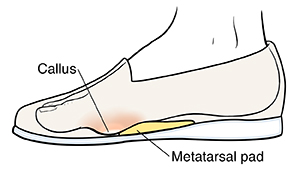
Using a metatarsal pad
Put a metatarsal pad in your shoe. This lifts and takes pressure off the painful area. To insert the pad:
-
Put a small lipstick mark on the callus.
-
Step into the shoe to leave a mark on the insole.
-
Peel the backing off the pad. Then put the pad in the shoe just behind the lipstick mark.
You may also be able to find inserts with built-in metatarsal pads.
Filing the callus
-
Soak your foot in warm water for a few minutes to soften the skin.
-
Dry the foot.
-
Gently rub the callus with a pumice stone or nail file to remove the hard skin. Stop if bleeding or pain occurs.
If you have diabetes, see your diabetes healthcare provider for foot care.
Online Medical Reviewer: Louise Cunningham RN BSN
Online Medical Reviewer: Raymond Turley Jr PA-C
Online Medical Reviewer: Thomas N Joseph MD
Date Last Reviewed: 09/01/2025
© 2000-2026 The StayWell Company, LLC. All rights reserved. This information is not intended as a substitute for professional medical care. Always follow your healthcare professional's instructions.
Need Help? We're Here for You
Our Member Services team is here to help you understand your benefits, find care, or resolve concerns.
1-800-510-9132
Call NC Quitline
Need support to quit smoking, vaping, or to quit other nicotine products? You can receive support including medicines free of charge:
1-800-784-8669
Schedule Transportation
Need transportation to a doctor's office, pharmacy, or other covered healthcare service? Contact us to arrange your ride.
1-800-510-9132
Provider Directory
Need to find a provider like a Primary Care Physician, Specialist, OB/GYN, or a Psychiatrist?
Provider DirectoryRelated Articles
Arthroscopy
Orthopedic surgeons use arthroscopy to diagnose and treat joint problems. An arthroscope is a small, tube shaped instrument that is used to look inside a joint.
Understanding Knee Replacement
The knee is a hinge-like joint, formed where the thighbone, shinbone, and kneecap meet. Over time, cartilage can wear away and the knee becomes stiff and painful. An artificial knee joint can replace the painful joint and restore movement. Learn more about the joints and knee replacement surgery.
Ankle Arthroscopy: Conditions Treated
Arthroscopy is used to find and treat ankle problems. These include loose bodies, bone spurs, osteochondritis dissecans (OCD), and synovitis.
Treating Corns and Calluses
Learn about the different treatments for corns or calluses.