When you first learn you have plantar fasciitis, your doctor will look for the cause of your problem. Then they can suggest ways to ease pain. If your pain is due to poor foot mechanics, sometimes custom-made shoe inserts (orthoses) may help.
Ease symptoms
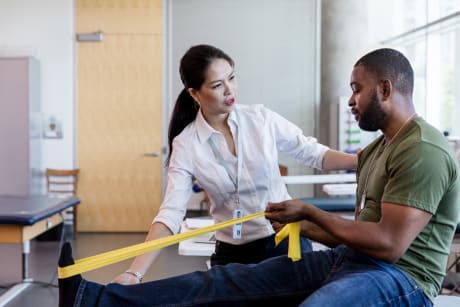
- To help ease symptoms, stretch. The treatment that works well for plantar fasciitis is stretching your calves and plantar fascia. The fascia is a fibrous structure that runs under the skin from your heel to your toes. Your doctor can give you a stretching program to do 2 to 3 times a day. If your symptoms are worse when first getting out of bed in the morning, stretch before getting out of bed. This can help because you are stretching before putting weight on your feet.
- To relieve mild symptoms, try ibuprofen, acetaminophen, or other medicines as directed by your doctor. Freezing a water bottle and gently messaging the area with the frozen water bottle may also help. Gel heel cup inserts in your shoes can help. Wear footwear that fits well and supports your foot.
- To reduce severe pain and swelling, your doctor may give you pills or injections. In some cases, you may need a walking cast or boot. Physical therapy, ultrasound therapy, or a daily stretching program may also be recommended. Surgery is rarely needed.
- To ease symptoms caused by poor foot mechanics, your foot may be taped or over-the-counter or custom-made orthotics may be used. This supports the arch and temporarily controls movement. Night splints may also help by stretching the fascia.
Control movement
If taping helps, your doctor may prescribe orthoses. These are inserts built from plaster casts of your feet. They control the way your foot moves. This may improve your symptoms.
Reduce overuse
Every time your foot strikes the ground, the plantar fascia is stretched. You can reduce the strain on the plantar fascia and the chance of overuse by:
- Losing any extra weight you may have.
- Not running on hard or uneven ground.
- Using orthoses, supportive footwear, or heel pads, if recommended, in your shoes and slippers or wear other cushioned footwear at home.
If surgery is needed
Your doctor may consider surgery if other types of treatment don't control your pain. During surgery, the plantar fascia is partially cut to release tension. As you heal, fibrous tissue fills the space between the heel bone and the plantar fascia.
Online Medical Reviewer: Rahul Banerjee MD
Online Medical Reviewer: Ronald Karlin MD
Online Medical Reviewer: Stacey Wojcik MBA BSN RN
Date Last Reviewed: 09/01/2025
© 2000-2026 The StayWell Company, LLC. All rights reserved. This information is not intended as a substitute for professional medical care. Always follow your healthcare professional's instructions.
Need Help? We're Here for You
Our Member Services team is here to help you understand your benefits, find care, or resolve concerns.
1-800-510-9132
Call NC Quitline
Need support to quit smoking, vaping, or to quit other nicotine products? You can receive support including medicines free of charge:
1-800-784-8669
Schedule Transportation
Need transportation to a doctor's office, pharmacy, or other covered healthcare service? Contact us to arrange your ride.
1-800-510-9132
Provider Directory
Need to find a provider like a Primary Care Physician, Specialist, OB/GYN, or a Psychiatrist?
Provider DirectoryRelated Articles
Surgery for Anterior Cruciate Ligament (ACL) Injury
The ACL (anterior cruciate ligament) is a band of tough, fibrous tissue that helps stabilize the knee. Injury to this ligament often happens when the knee is forced beyond its normal range of motion.
Osteotomy and Ligament or Tendon Repair (Bunion Surgery)
Learn what you can expect before, during, and after bunion surgery.
Kneecap (Patella) Surgery: Realignment
Some procedures may be done using arthroscopy, a method that uses tiny incisions and special instruments to look and work inside the knee joint. Other procedures need open surgery. The kneecap can be realigned to improve its tracking. To do this, soft tissue may be cut, tightened, or moved.
Treating Ankle Sprains
Learn how to treat ankle sprains.