The hip joint is one of the body’s largest weight-bearing joints. It is a ball-and-socket joint. It keeps the hip stable even during twisting and extreme ranges of motion. A healthy hip joint allows you to walk, squat, and turn without pain. But when a hip joint is damaged, it is likely to hurt when you move. When a natural hip must be replaced, a prosthesis is used.
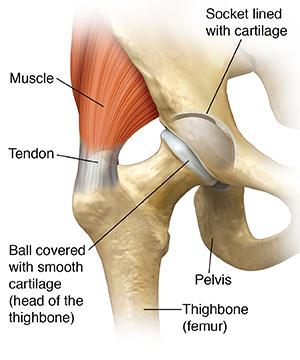
A healthy hip
In a healthy hip, smooth cartilage covers the ends of the thighbone, as well as the pelvis where it joins the thighbone. This allows the ball to glide easily inside the socket with little friction. When the surrounding muscles support your weight and the joint moves smoothly, you can walk painlessly.
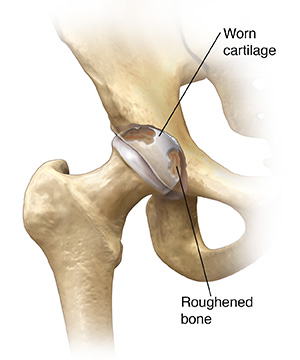
A problem hip
In a problem hip, the worn cartilage no longer serves as a cushion. As the roughened bones rub together, they become irregular, with a surface like sandpaper. The ball grinds in the socket when you move your leg, causing pain and stiffness.
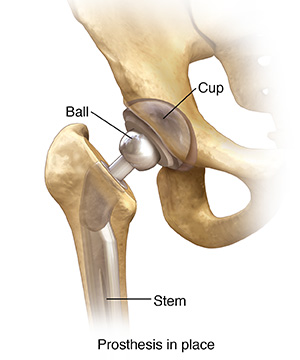
A prosthesis
An artificial ball replaces the head of the thighbone and an artificial cup replaces the worn socket. A metal stem is inserted into the thigh bone to keep the ball in place.
These parts connect to create your new artificial hip.
A liner, usually made of plastic or ceramic, is placed between the metal or ceramic ball and cup to create a smooth surface for comfortable movement once you have healed.
Online Medical Reviewer: Marianne Fraser MSN RN
Online Medical Reviewer: Raymond Turley Jr PA-C
Online Medical Reviewer: Vinita Wadhawan Researcher
Date Last Reviewed: 12/01/2024
© 2000-2026 The StayWell Company, LLC. All rights reserved. This information is not intended as a substitute for professional medical care. Always follow your healthcare professional's instructions.
Need Help? We're Here for You
Our Member and Recipient Services Team is here to help you understand your benefits, find care, or resolve concerns.
800-510-9132
Call NC Quitline
Need support to quit smoking, vaping, or to quit other nicotine products? You can receive support including medicines free of charge:
800-784-8669
Schedule Transportation
Need transportation to a doctor's office, pharmacy, or other covered healthcare service? Contact us to arrange your ride.
800-510-9132
Provider Directory
Need to find a provider like a Primary Care Physician, Specialist, OB/GYN, or a Psychiatrist?
Provider DirectoryRelated Articles
Neck Problems: Relieving Your Symptoms
These self-care treatments can help ease your neck pain.
Foot Surgery: Bone Spurs
A bone spur (an extra bone growth) can make walking and wearing shoes painful. There are several nonsurgical treatments for bone spurs. But if these aren't effective, surgery can be considered.
Surgery for Anterior Cruciate Ligament (ACL) Injury
The ACL (anterior cruciate ligament) is a band of tough, fibrous tissue that helps stabilize the knee. Injury to this ligament often happens when the knee is forced beyond its normal range of motion.
Hip Fracture Surgery: Types
The type of surgery you have often depends on where the hip is fractured. Read on to learn more.


