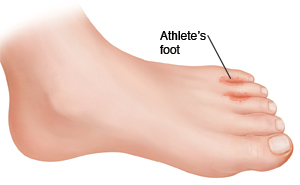
Athlete’s foot (tinea pedis) is caused by a fungal infection in the skin. It's sometimes called ringworm even though a worm doesn't cause the infection. Athlete’s foot affects the skin between the toes, causing cracks in the skin called fissures. It can also affect the bottom of the foot where it causes dry white scales and peeling of the skin. This infection is more likely to occur when the foot is in hot, sweaty socks and shoes for long periods of time. You may feel itching and burning between your toes. This infection is treated with skin creams or medicine taken by mouth.
Home care
The following are general care guidelines:
-
It's important to keep the feet dry. Use absorbent cotton socks and change them if they become sweaty. Or wear an open-toe shoe or sandal.
-
Wash the feet at least once a day with soap and water, and dry them well.
-
If your health care provider prescribed an antifungal medicine, use it as prescribed.
-
Some antifungal creams are available without a prescription. Follow the instructions on the medicine package.
-
It may take 1 week before the rash starts to improve. It can take about 3 to 4 weeks to completely clear. Continue the medicine until the rash is all gone.
-
Use over-the-counter antifungal powders or sprays on your feet after exposure to high-risk environments, such as public showers, gyms, swimming pools, and locker rooms. This can help prevent future infections. Wearing appropriate shoes or sandals in these situations can help.
Prevention
These tips may help prevent athlete’s foot:
-
Don't share shoes, socks, towels, or sports equipment with someone who has athlete's foot.
-
Don't walk barefoot in places where a fungal infection can spread quickly, such as locker rooms, showers, gyms, and swimming pools.
-
Change your socks regularly. Don't wear the same socks for more than 1 day.
-
Alternate shoes to help with drying, or wear shoes that allow airflow.
-
Dry your feet well after swimming or bathing.
Follow-up care
Follow up with your provider as advised if the rash doesn't improve after 10 days of treatment, or if the rash continues to spread.
When to contact your doctor
Contact your provider right away if:
-
You have a fever of 100.4°F (38°C) or higher, or as directed by your provider.
-
Redness or swelling of the foot increases.
-
The infection comes back soon after treatment.
-
Pus drains from cracks in the skin.
Online Medical Reviewer: Jessica Gotwals BSN MPH
Online Medical Reviewer: Michael Lehrer MD
Online Medical Reviewer: Ronald Karlin MD
Date Last Reviewed: 02/01/2025
© 2000-2026 The StayWell Company, LLC. All rights reserved. This information is not intended as a substitute for professional medical care. Always follow your healthcare professional's instructions.
Need Help? We're Here for You
Our Member and Recipient Services Team is here to help you understand your benefits, find care, or resolve concerns.
800-510-9132
Call NC Quitline
Need support to quit smoking, vaping, or to quit other nicotine products? You can receive support including medicines free of charge:
800-784-8669
Schedule Transportation
Need transportation to a doctor's office, pharmacy, or other covered healthcare service? Contact us to arrange your ride.
800-510-9132
Provider Directory
Need to find a provider like a Primary Care Physician, Specialist, OB/GYN, or a Psychiatrist?
Provider DirectoryRelated Articles
Understanding Epidermoid Cyst
An epidermoid cyst is a small abnormal growth in the top layers of the skin. These cysts grow slowly, and they can grow anywhere on the body. Learn about causes, symptoms, and treatment.
Understanding Tinea Unguium
Tinea unguium is a type of fungal infection. The fungus infects the fingernails and, more commonly, the toenails. It's more common in men, older adults, and people who have diabetes or peripheral vascular disease.
Ringworm of the Scalp
Ringworm is caused by a fungus, not a worm. It's passed from animals or people infected with the fungus. Here's what you need to know about caring for yourself at home.
Facial Bruise (Contusion)
A facial contusion can cause swelling, pain, and changes in skin color.


