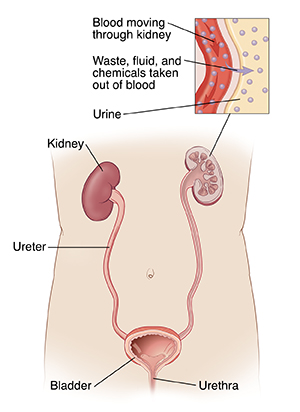
The kidneys’ main job is to clean the blood. They filter wastes and excess fluids from your blood each day. This helps maintain the chemical balance the body needs to stay healthy and alive. One working kidney, even part of a kidney, is enough to do this job. If both kidneys fail, their work must then be done another way.
Kidneys filter the blood
Your 2 kidneys are located just above your waist and below your rib cage toward your back, on either side of the spine. They are bean-shaped and the size of your fist. They filter blood through filtering units called nephrons. There are about 1 million nephrons per kidney. The nephrons:
-
Remove waste and fluid. The kidneys take waste products, such as urea, from the blood. They also remove unneeded fluid.
-
Balance chemicals. The body needs chemicals (such as calcium, sodium, potassium, and phosphorus) to work. Too little or too much of them can make you sick. In the kidneys, chemicals are taken from or added to the blood. This keeps them in the right balance.
The kidneys’ other tasks
In addition to filtering the blood, the kidneys do other tasks. These include:
-
Making erythropoietin to tell the bone marrow to make red blood cells (erythrocytes). These are the cells in the blood that carry oxygen.
-
Helping control blood pressure by making and releasing the enzyme renin.
-
Helping keep bones strong by making a form of vitamin D called calcitriol.
The kidneys may be damaged by a number of conditions. These include:
-
Diabetes
-
High blood pressure
-
Smoking
-
Inherited conditions
-
Immune disorders
-
Injury
-
Certain medicines
Online Medical Reviewer: Marianne Fraser MSN RN
Online Medical Reviewer: Raymond Kent Turley BSN MSN RN
Online Medical Reviewer: Walead Latif MD
Date Last Reviewed: 07/01/2024
© 2000-2026 The StayWell Company, LLC. All rights reserved. This information is not intended as a substitute for professional medical care. Always follow your healthcare professional's instructions.
Need Help? We're Here for You
Our Member and Recipient Services Team is here to help you understand your benefits, find care, or resolve concerns.
800-510-9132
Call NC Quitline
Need support to quit smoking, vaping, or to quit other nicotine products? You can receive support including medicines free of charge:
800-784-8669
Schedule Transportation
Need transportation to a doctor's office, pharmacy, or other covered healthcare service? Contact us to arrange your ride.
800-510-9132
Provider Directory
Need to find a provider like a Primary Care Physician, Specialist, OB/GYN, or a Psychiatrist?
Provider DirectoryRelated Articles
Hemodialysis Access Bleeding
You have a hemodialysis access in your arm, either an arteriovenous (AV) fistula or an artery to vein graft. It has been bleeding. Blood needs to flow freely through the fistula or graft. As part of your treatment, you are also taking medication that thins your blood. This makes you bleed more easily. It is important to stop your fistula or graft from bleeding as soon as possible.
Shock Wave Lithotripsy
Shock wave lithotripsy is a treatment that breaks a kidney stone into smaller pieces that are easier to pass. This treatment is also called extracorporeal shock wave lithotripsy (ESWL).
Kidney Stone with Pain
Learn how to care for yourself after being diagnosed with kidney stones.
Anatomy of the Bladder
The bladder is a hollow organ in your lower belly. Learn about its anatomy.


